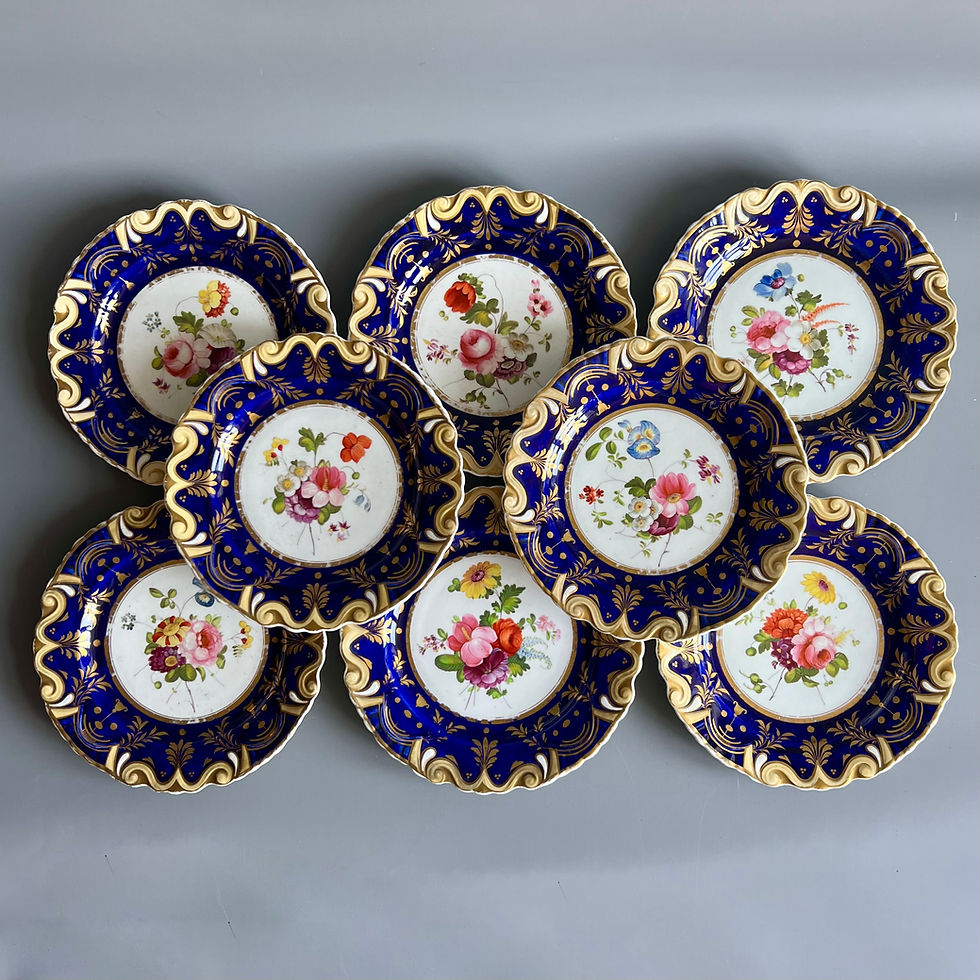
This is a stunning dessert service made by Spode in 1822, which was the Regency era. The service is made of Felspar porcelain and decorated in a beautiful pale yellow colour with an "Oeil de Perdrix" pattern and top quality floral reserves. The service consists of two lidded sauce tureens with stands, two deep rectangular dishes, two lozenge shaped dishes, one square dish, and six square dessert plates.
Spode was the great pioneer among the Georgian potters in England. Around the year 1800 he perfected the bone china recipe that has been used by British potters ever since, and he was also the leading potter behind the technique of transferware, making it possible for English potters to replace the Chinese export china, which had come to an end around that time, with their own designs. This was fundamental to a thriving industry that would last for about 150 years and provide half the world with their tableware. Spode porcelain is regarded as one of the highest quality porcelains around; for a soft-paste porcelain it is surprisingly hard and fine, and has a wonderful bright white colour.
This dessert service was potted in "Felspar" porcelain, which was a new recipe that Spode brought out in the early 1820s. Felspar porcelain is a little heavier than the normal bone china, but it is as strong and beautiful, and as it doesn't chip as easily it was very popular for dinner and dessert services.
This shape of dessert service is very desired; the most popular thing about is of course the spectacular handles of the sauce tureens and lids, which are in the shape of gilded butterflies. Other notable things about the shape is the beautifully moulded rims with little roses moulded into them, and the leaf handles of the rectangular dishes, which have a gilt detail around the rim onto the underside. The pale yellow colour is a very rare colour as it was prohibitively expensive to produce at the time; if they got the temperature of the kiln only slightly wrong, the colour would come out brown so there would have been a high rate of failure during the firing process. The yellow ground is covered with a Sevres-style "Oeil de Perdrix" pattern in gilt. The centre of each item, and all available spaces on and inside the sauce tureens, have stunning flower paintings. These flowers were fashionable at the time and you can find them on most tableware, but these particular ones were painted by a master painter and have true artistic freedom. One plate has a bit more gilding on the rim; it has a slightly later pattern number but basically the pattern is the same so the plate fits perfectly.
The items have the printed "Spode Felspar Porcelain" mark on the underside, as well as the pattern number 3414, which points to production in the year 1822. One plate has the pattern number 3674, which is basically the same pattern but with a bit more gilding.
CONDITION REPORT The service is in perfect antique condition without any damage, crazing or repairs and not even any wear - except one of the butterfly finials, which has been professionally replaced. It can't be overstated how rare it is to find these items with hardly any damage or wear so this is a unique find.
Antique British porcelain is never perfect. Kilns were fired on coal in the 1800s, and this meant that china from that period can have some firing specks from flying particles. British makers were also known for their experimentation, and sometimes this resulted in technically imperfect results. Due to the shrinkage in the kiln, items can have small firing lines or develop crazing over time, which should not be seen as damage but as an imperfection of the maker's recipes, probably unknown at the time of making. Items have often been used for many years and can have normal signs of wear, and gilt can have signs of slight disintegration even if never handled. I will reflect any damage, repairs, obvious stress marks, crazing or heavy wear in the item description but some minor scratches, nicks, stains and gilt disintegration can be normal for vintage items and need to be taken into account.
There is widespread confusion on the internet about the difference between chips and nicks, or hairlines and cracks. I will reflect any damage as truthfully as I can, i.e. a nick is a tiny bit of damage smaller than 1mm and a chip is something you can easily see with the eye; a glazing line is a break in the glazing only; hairline is extremely tight and/or superficial and not picked up by the finger; and a crack is obvious both to the eye and the finger. Etcetera - I try to be as accurate as I can and please feel free to ask questions or request more detailed pictures!
DIMENSIONS: sauce tureens 18.8cm (7.4") high and 15.2cm (6") diameter incl. stands and covers; rectangular dishes 28cm X 18cm (11" X 7.1"); lozenge shaped dishes 25.5cm X 18.5cm (10" X 7.25"); square dish 20.5cm (8") diameter; plates 23.5cm (9.25") diameter.