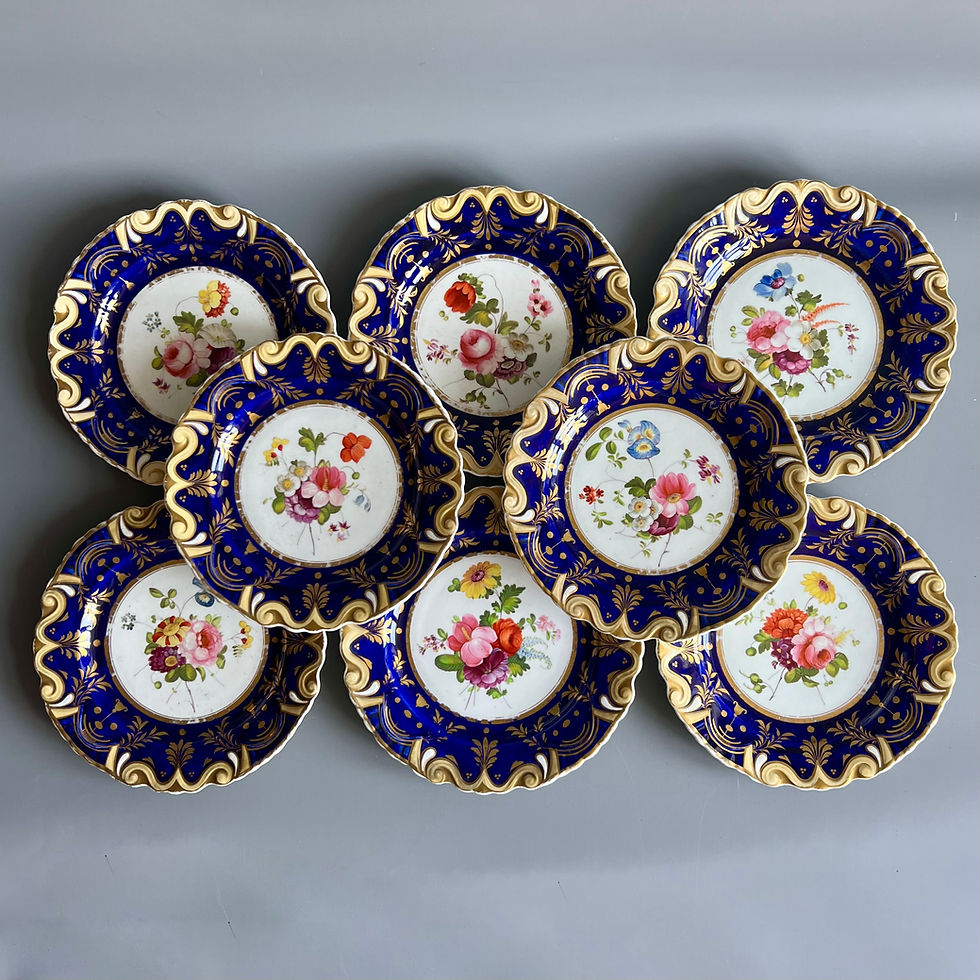
This is a stunning dessert service made by Minton probably around the year 1830, in their "second period". The service consists of a high footed centre piece, two square dishes, two oval dishes, two round dishes, and ten plates. It is decorated in a very restrained and elegant pattern of a monochrome printed pattern of flowers (among which are roses, anemones and passion flowers), and simpel gilt details. The shape is iconic with the moulded shells and pierced handles.
Minton was one of the pioneers of English china production alongside other great potters such as Spode, Davenport, Ridgway, Coalport and others. They were located in Staffordshire and were known specifically for their wonderfully fine white bone china and top quality designs. Between 1798 and 1816 they made very fine porcelain with wonderful neoclassical designs. After a break during an economic crisis, they started their second period in 1824, creating Rococo Revival designs such as this "inverted shell" or "dropped shell" shape.
This design could easily be confused with the work of several other factories; it was also made by Alcock, Rathbone, Machin, Ridgway, New Hall, Hicks & Meigh, Rathbone and Minton, and possibly others. Based on the combination of the flawless quality of the porcelain and the fine printing, it is likely that this was made by Minton, however the pattern with the number 302 seems to be from their first period.
This service has provenance: as you can see from a label on the underside of the comport it was for sale in Geoffrey A. Godden's shop. He offered the comport for £750 and the whole service for £3,250 (this is many years ago, when the pound had a much higher value!). He identified it as Minton and dated it to 1830-1835; I would suggest it might have been a little earlier but as they used an older pattern, we can't tell exactly.
CONDITION REPORT The whole service is in perfect antique condition without any damage, repairs or crazing other than one single chip on the uderside of the rim of one of the dishes, not visible when in position. There is some light rubbing to the gilding of a few pieces; most are pristine.
Antique British porcelain is never perfect. Kilns were fired on coal in the 1800s, and this meant that china from that period can have some firing specks from flying particles. British makers were also known for their experimentation, and sometimes this resulted in technically imperfect results. Due to the shrinkage in the kiln, items can have small firing lines or develop crazing over time, which should not be seen as damage but as an imperfection of the maker's recipes, probably unknown at the time of making. Items have often been used for many years and can have normal signs of wear, and gilt can have signs of slight disintegration even if never handled. I will reflect any damage, repairs, obvious stress marks, crazing or heavy wear in the item description but some minor scratches, nicks, stains and gilt disintegration can be normal for vintage items and need to be taken into account.
There is widespread confusion on the internet about the difference between chips and nicks, or hairlines and cracks. I will reflect any damage as truthfully as I can, i.e. a nick is a tiny bit of damage smaller than 1mm and a chip is something you can easily see with the eye; a glazing line is a break in the glazing only; hairline is extremely tight and/or superficial and not picked up by the finger; and a crack is obvious both to the eye and the finger. Etcetera - I try to be as accurate as I can and please feel free to ask questions or request more detailed pictures!
DIMENSIONS please feel free to ask for details; the plates are about 23cm (9") in diameter.