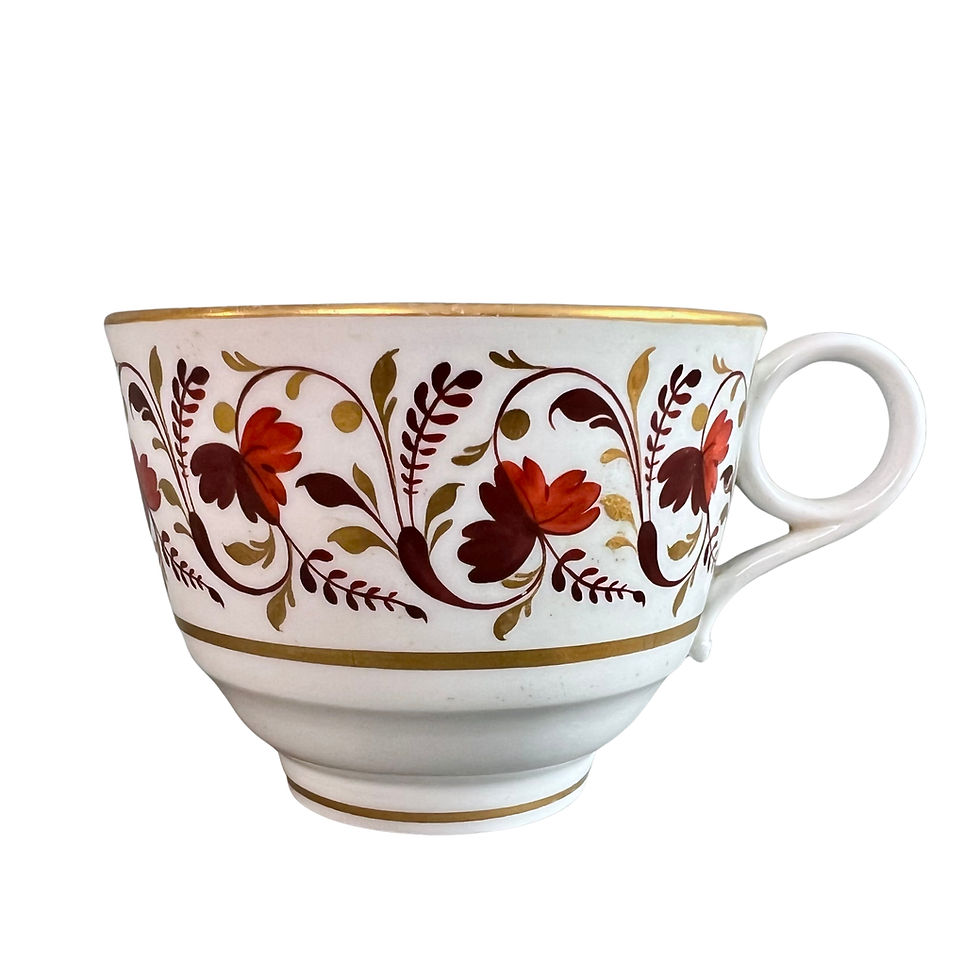
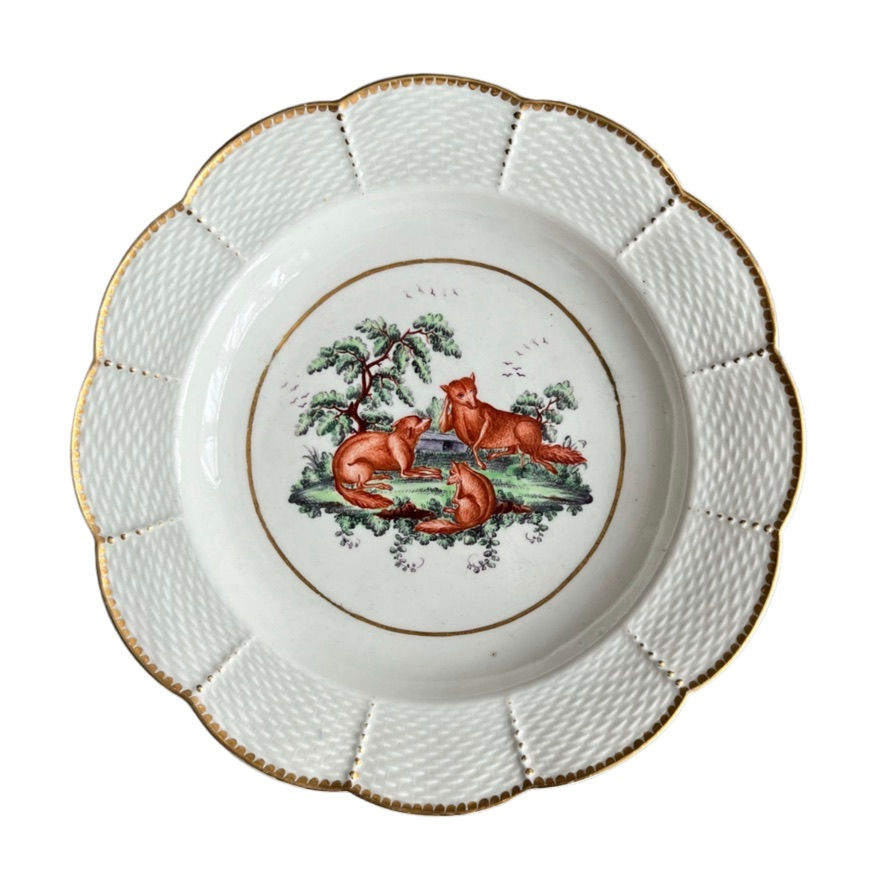
This is a beautiful and very rare dessert service made by Flight, Barr & Barr between 1815 and 1820. The service consists of a central comport, two sauce tureens with covers, a square dish, two round dishes and six dessert plates.
Flight, Barr & Barr was the continuation of the famous Worcester Porcelain Company. In fact the factory went through various partnerships and names, most of which involved either the name Barr, Flight, or both (or double!). This confusing period in the factory's existence is often called the "Flight & Barr" period. Eventually the factory absorbed some of its spin-offs and was turned into the Royal Worcester, which became very famous in the late 19th and 20th Centuries. During the late 18th and entire 19th Century they were among the leaders of china production, producing exceptionally finely painted and sculpted forms.
This service is finely potted in very white porcelain in the simple shape that was characteristic before 1820. The sauce tureens have wonderful eagle heads holding rings, and finials in the shape of flames, both of which have been replaced. The decoration consists of a famous pattern of brown vines with little red berries and beautiful gilding. We date this service between 1815 and 1820, based on the shape of the items and the quality of the porcelain.
Many items of this service have the impressed crowned FBB mark.
CONDITION REPORT The service is in excellent condition with very few flaws; both finials of the sauce comports have been replaced with copies. There is some wear throughout, and some rubbing to the gilt mostly on one of the round dishes and two of the plates. Other than these small flaws there is no damage or crazing.
The finials have been repaired a long time ago and for an additional fee we can get them restored to a much higher quality and painted over with matching gilt; we can discuss if you are interested.
Antique British porcelain is never perfect. Kilns were fired on coal in the 1800s, and this meant that china from that period can have some firing specks from flying particles. British makers were also known for their experimentation, and sometimes this resulted in technically imperfect results. Due to the shrinkage in the kiln, items can have small firing lines or develop crazing over time, which should not be seen as damage but as an imperfection of the maker's recipes, probably unknown at the time of making. Items have often been used for many years and can have normal signs of wear, and gilt can have signs of slight disintegration even if never handled. I will reflect any damage, repairs, obvious stress marks, crazing or heavy wear in the item description but some minor scratches, nicks, stains and gilt disintegration can be normal for vintage items and need to be taken into account.
There is widespread confusion on the internet about the difference between chips and nicks, or hairlines and cracks. I will reflect any damage as truthfully as I can, i.e. a nick is a tiny bit of damage smaller than 1mm and a chip is something you can easily see with the eye; a glazing line is a break in the glazing only; hairline is extremely tight and/or superficial and not picked up by the finger; and a crack is obvious both to the eye and the finger. Etcetera - I try to be as accurate as I can and please feel free to ask questions or request more detailed pictures!
DIMENSIONS (diameter): comport 35 X 25 X 10cm (13.75" X 9.75" X 4"); sauce tureens 16 X 13 (6.25" X 5") and 17cm (6.75") high; square dish 22.5 X 22.5cm (8.8" X 8.8")and 4cm (1.5") high; round dishes 19.5 X 19cm (7.75" X 7.5") and 4cm (1.5") high; plates 21cm (8.25").