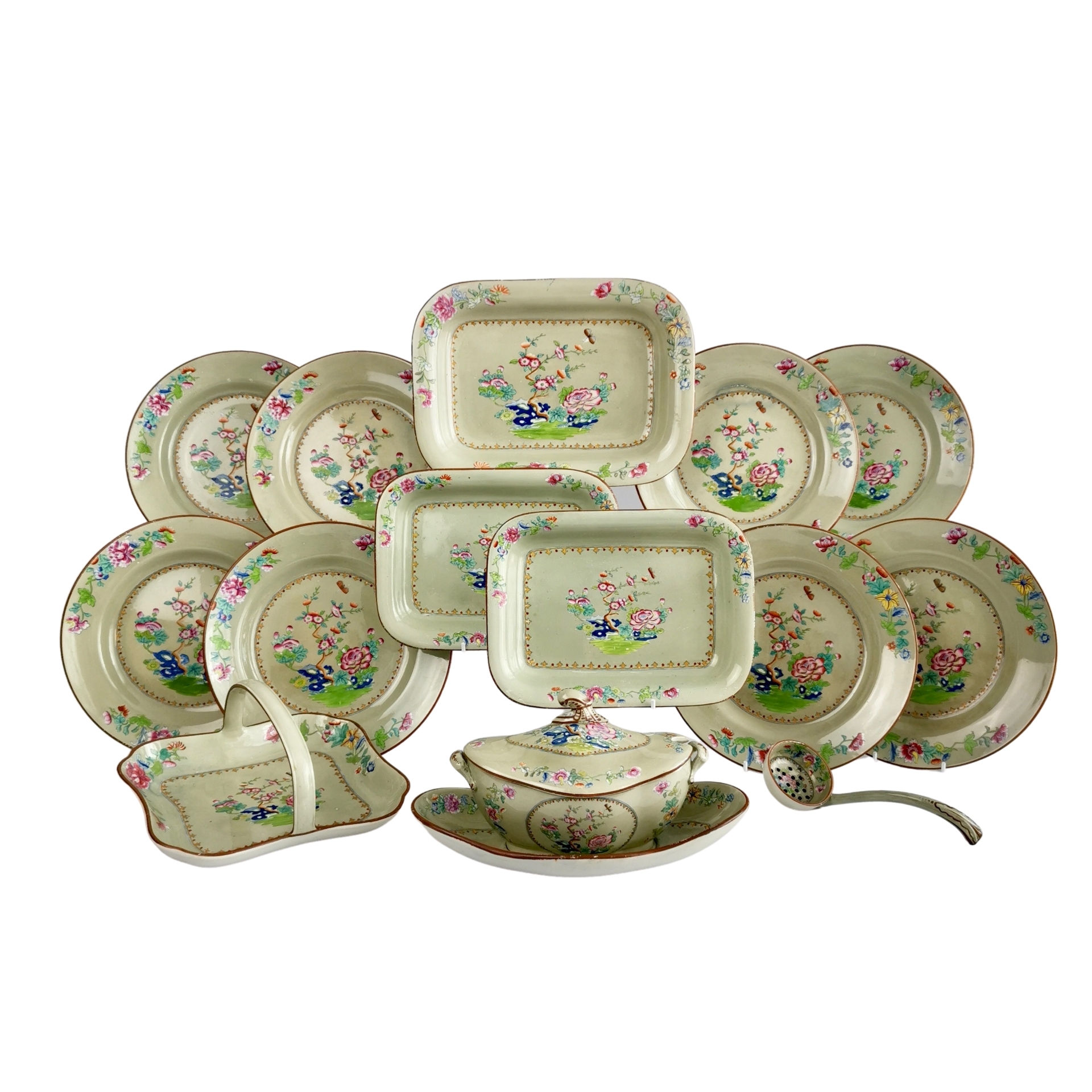

This is a beautiful Spode creamware dessert service made in or shortly after 1814. The service is decorated in a printed and hand-coloured Chinoiserie design on an avocado green ground, called the Willis pattern with the number 2147. The service consists of three rectangular dishes, a bread basket, a lidded fruit compote tureen on a stand with a perforated ladle, and eight plates.
Spode was the great pioneer among the Georgian potters in England. Around the year 1800 he perfected the bone china recipe that has been used by British potters ever since, and he was also the leading potter behind the technique of transferware, making it possible for English potters to replace the Chinese export china, which had come to an end around that time, with their own designs. This was fundamental to a thriving industry that would last for about 150 years and provide half the world with their tableware. Spode porcelain is regarded as one of the highest quality porcelains around; for a soft-paste porcelain it is surprisingly hard and fine, and has a wonderful bright white colour. Spode also made many table ware services in creamware, pearlware and stone china.
Blue on white decorations were done in East Asia for many centuries, and were made popular in the West by the Dutch Delftware potters in the 17th Century. In about 1800, Spode created a transfer printing process that could mass produce beautifully decorated blue and white wares, making this a very common and desired choice of tableware for the two centuries to come. Potters all over Britain quickly started to make use of this new technology and copied the famous Spode patterns. Once the blue on white transfers had caught on, Spode started to print in colour; mostly printing in one colour on top of a ground colour (in this case: light blue on avocado green) and then filling in the other colours by hand. This way, they could offer wonderfully colourful dinner services at a much lower cost, as they needed only a skilled engraver for the plate that provided the outline of the image, and the transferring and colouring could be done by less skilled people. These were often women and apprenticed teenage children.
This service has an elegant Regency shape and is potted in light creamware. As is very rare for dessert services of this era, one sauce tureen with a lid and a stand and even a perforated ladle have survived in perfect condition. It also has a charming bread basket with an overhead handle.
The Willis pattern was recorded in 1814 with pattern number 2147. The pattern is an imitation of an original Chinese design from the Yongzheng period (1723-1735) with beautiful peonies and prunus blossom growing near some rocks, with more flowers in the rim.
All items carry the imprinted "Spode" mark.
A picture of this pattern can be found in colour plate IX of Leonard Whiter's book "Spode", and on pages 43 and 55 of Smith, “Spode & Copeland: Over 200 Years of Fine China and Porcelain”.
CONDITION REPORT The service is in excellent antique condition without any damage or repairs and only light wear and flaking of the images, as visible in the pictures. As is usual for creamware items of this era, the items fine crazing.
Antique British china is never perfect. Kilns were fired on coal in the 1800s, and this meant that china from that period can have some firing specks from flying particles. British makers were also known for their experimentation, and sometimes this resulted in technically imperfect results. Due to the shrinkage in the kiln, items can have small firing lines or develop crazing over time, which should not be seen as damage but as an imperfection of the maker's recipes, probably unknown at the time of making. Items have often been used for many years and can have normal signs of wear, and gilt can have signs of slight disintegration even if never handled. I will reflect any damage, repairs, obvious stress marks, crazing or heavy wear in the item description but some minor scratches, nicks, stains and gilt disintegration can be normal for vintage items and need to be taken into account.
There is widespread confusion on the internet about the difference between chips and nicks, or hairlines and cracks. I will reflect any damage as truthfully as I can, i.e. a nick is a tiny bit of damage smaller than 1mm and a chip is something you can easily see with the eye; a glazing line is a break in the glazing only; hairline is extremely tight and/or superficial and not picked up by the finger; and a crack is obvious both to the eye and the finger. Etcetera - I try to be as accurate as I can and please feel free to ask questions or request more detailed pictures!
DIMENSIONS Sauce tureen 24cm by 14cm (9.5" by 5.5") and 12cm (4.75") high incl. cover and stand; largest rectangular dish 27cm by 20cm (10.5" by 8"); smaller rectangular dishes 22cm by 16cm (8.75" by 6.25"); basket 20cm by 17.5cm (8" by 7") and 10cm (4") high; plates 22cm (8.75") diameter.


