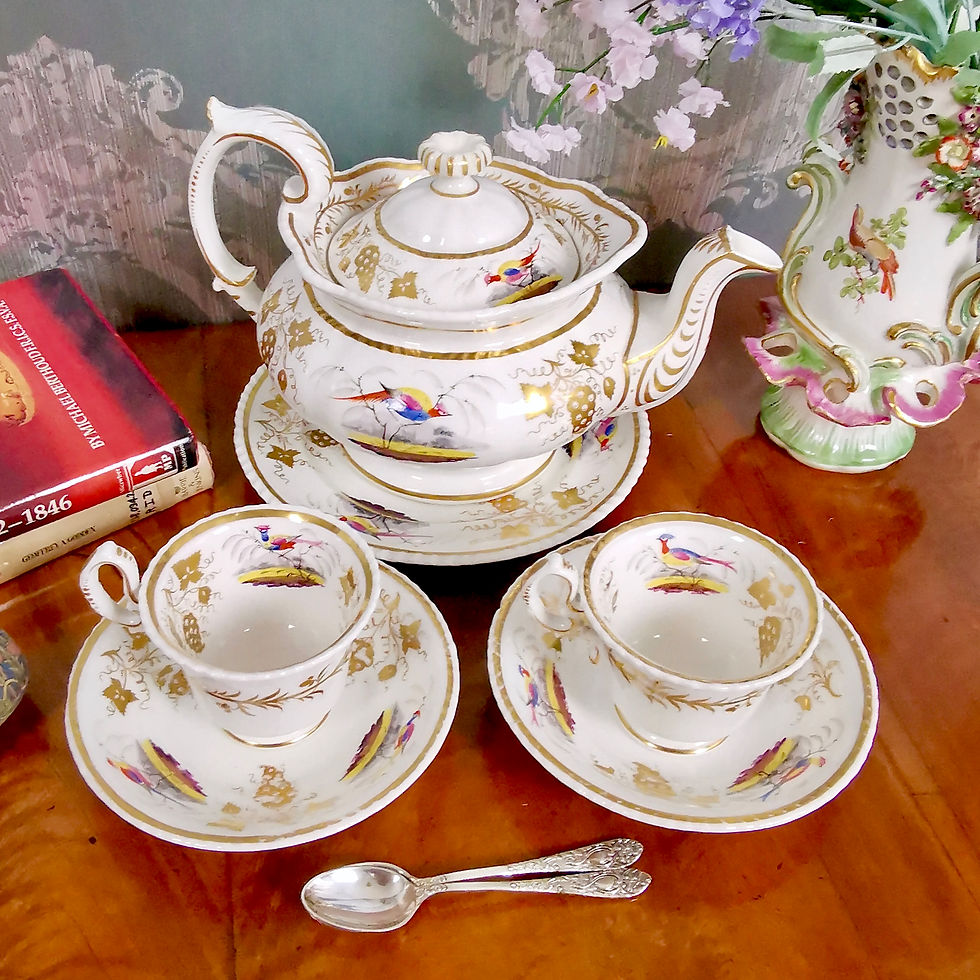
This is an extremely rare Belleek cabaret set for two, or "tête-à-tête", made in the Erne series brought out in the 1890s. The items carry the 2nd Black Mark, used between 1891 and 1926. The set consists of a teapot, a milk jug, a sugar bowl, two teacups and saucers, and a large matching tray.
This set is very fine and with its restrained cream-white colour it would make a wonderful wedding gift!
If you ever thought Belleek fine china looks, sounds and feels unique, you are right. There is a back story to this extraordinarily fine Irish eggshell porcelain, which has an unusually high amount of "frit" and therefore is thinner and finer than any other china.
Pottery in Belleek (in the now Northern-Irish area of Fermanagh) had started in 1849 with John Caldwell Bloomfield, who was a wealthy land owner. During the Irish famine he realised that unless he would find a way for his tenants to make a profit off the land, they would starve. Agriculture had become impossible due to the agricultural diseases. This caused millions to starve and more millions to leave. As an amateur mineralogist, John Caldwell Bloomfield realised that his land had exactly the right mineral deposits to be used as clay for porcelain. He involved several investors and scientists and after many years of research, trial, error, the building of a railway line to import coal from England, and building a factory, the Belleek pottery resulted, employing the local people and soon producing the finest china made with clay from the Belleek area.
What had started as a way to fend off famine among the local tenants had became a story of incredible success by the 1880s as Queen Victoria fell in love with the fine white china and the many homely, slightly bizarre but nature-loving designs; this was different from English tradition, yet it was very much to the taste of the British who had developed a real love for home-made fine china since it was introduced in the late 18th Century. Belleek not only brought out many tea services, but started a new tradition of intricately woven porcelain baskets. Soon the English nobility started to place big orders and the pottery is still flourishing today and selling its wares the world over, while in England most potteries have long disappeared.
Belleek made many cabaret services, often called breakfast services or "tête-à-tête" services; these were used to carry breakfast tea up to the bedroom. Queen Victoria bought one in the Echinus style during a visit to the factory in the 1860s, and ever since Belleek's cabaret services have been in great demand. Nowadays there are very few of these left and it is rare to find a full service like this.
The Erne series was named after the river right besides the Belleek factory. This river forms the border between the Republic of Ireland and Northern Ireland, with the factory on the Northern Irish end of the bridge at Belleek. The pattern seems to be a play on the baskets and nets of the fishermen who once fished the abundant trout and salmon on the river Erne and the lake that belongs to it.
The items carry the second Black Mark, which was used between 1891 and 1926, however the very fine quality of the porcelain indicates that most pieces of the set are more likely to be from the 1890s than from the 20th Century. You will see that the shade of cob lustre is different on each item; this is normal for Belleek tea sets as they were often assembled over time, and Belleek was notorious for always slightly changing their colours.
CONDITION REPORT The set is in near-perfect antique condition, with only one small flaw: there is a faint star crack in the bottom of the sugar bowl. But as the bowl will not be used for hot liquids, the bowl is still fine to use. Other than this the set is free from any damage, repairs or crazing.
Antique porcelain is never perfect. Kilns were fired on coal in the 1800s, and this meant that china from that period can have some firing specks from flying particles. British makers were also known for their experimentation, and sometimes this resulted in technically imperfect results. Due to the shrinkage in the kiln, items can have small firing lines or develop crazing over time, which should not be seen as damage but as an imperfection of the maker's recipes, probably unknown at the time of making. Items have often been used for many years and can have normal signs of wear, and gilt can have signs of slight disintegration even if never handled. I will reflect any damage, repairs, obvious stress marks, crazing or heavy wear in the item description but some minor scratches, nicks, stains and gilt disintegration can be normal for vintage items and need to be taken into account.
There is widespread confusion on the internet about the difference between chips and nicks, or hairlines and cracks. I will reflect any damage as truthfully as I can, i.e. a nick is a tiny bit of damage smaller than 1mm and a chip is something you can easily see with the eye; a glazing line is a break in the glazing only; hairline is extremely tight and/or superficial and not picked up by the finger; and a crack is obvious both to the eye and the finger. Etcetera - I try to be as accurate as I can and please feel free to ask questions or request more detailed pictures!
DIMENSIONS The pot stands 11cm (4.3") high to the top of the finial and measures 20cm (7.9") from handle to spout. The jug stands 7cm (2.75") high and measures 10.25cm (4.15") from mouth to handle. Bowl stands 5cm (2") high and is 9.3cm (3.75") in diameter. Teacup is 8.8cm (3.5") diameter, saucer is 13cm (5.15") diameter. The tray measures 43cm (17") diameter.