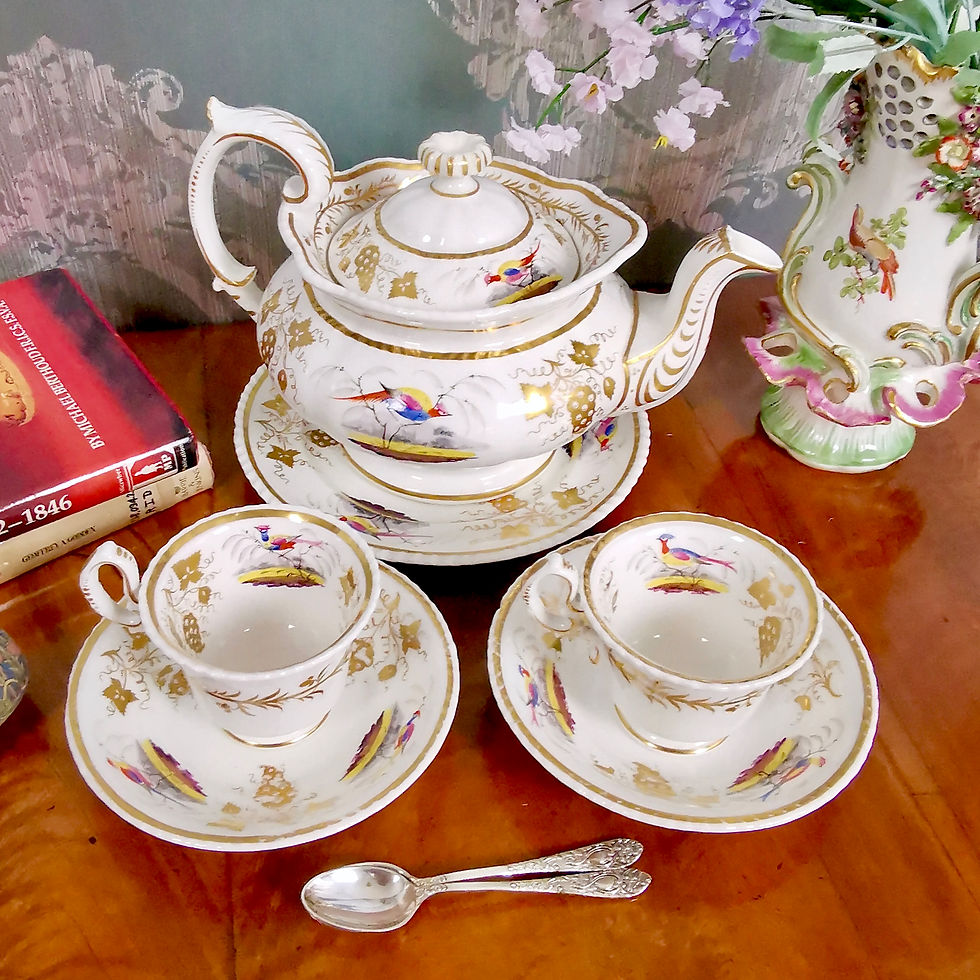
This is a beautiful coffee cup and saucer made by C J Mason around 1830, which was the George IV era. The items are decorated with beautiful transfer printed birds and Chinoiserie details in orange and terracotta. C.J. Mason was the youngest son of Miles Mason, one of the early ones of the second wave of British porcelain makers alongside Spode and others. Miles Mason was a prominent porcelain retailer in London at the time that most porcelain came from China, imported by the East India Company. When those imports stopped in 1791 (due to the racketeering at the porcelain auctions by Mason and his fellow dealers), he seized the opportunity and started to experiment in making his own porcelain. By the early 1800s, Mason had developed both very strong ironstone, and bone china. The Masons copied the Chinese designs they used to import and became famous for large Chinoiserie dinner and dessert wares made of "Patent Ironstone", which was a new form of porcelain that was patented by C. J. Mason. However, they also made very fine porcelain tea services. This set would have been part of such a large tea service. In those days, tea services came with coffee cups as well. This set has a nice natural Rococo Revival shape (you can see that the handle looks like a naturally grown twig) and decorated with a beautiful transfer print of the kind the Masons were famous for. Birds and Chinoiserie details are printed in terracotta, then hand coloured in fiery oange/red and picked off with a bit of gilt. The set is unmarked as was common at the time. CONDITION REPORT The set is in excellent antique condition without any damage, repairs or crazing. There is light wear as visible in the pictures. Antique British porcelain is never perfect. Kilns were fired on coal in the 1800s, and this meant that china from that period can have some firing specks from flying particles. British makers were also known for their experimentation, and sometimes this resulted in technically imperfect results. Due to the shrinkage in the kiln, items can have small firing lines or develop crazing over time, which should not be seen as damage but as an imperfection of the maker's recipes, probably unknown at the time of making. Items have often been used for many years and can have normal signs of wear, and gilt can have signs of slight disintegration even if never handled. I will reflect any damage, repairs, obvious stress marks, crazing or heavy wear in the item description but some minor scratches, nicks, stains and gilt disintegration can be normal for vintage items and need to be taken into account.

There is widespread confusion on the internet about the difference between chips and nicks, or hairlines and cracks. I will reflect any damage as truthfully as I can, i.e. a nick is a tiny bit of damage smaller than 1mm and a chip is something you can easily see with the eye; a glazing line is a break in the glazing only; hairline is extremely tight and/or superficial and not picked up by the finger; and a crack is obvious both to the eye and the finger. Etcetera - I try to be as accurate as I can and please feel free to ask questions or request more detailed pictures! DIMENSIONS (diameters) coffee cup 7.7cm (3.1"); saucer 14.8cm (5.8").