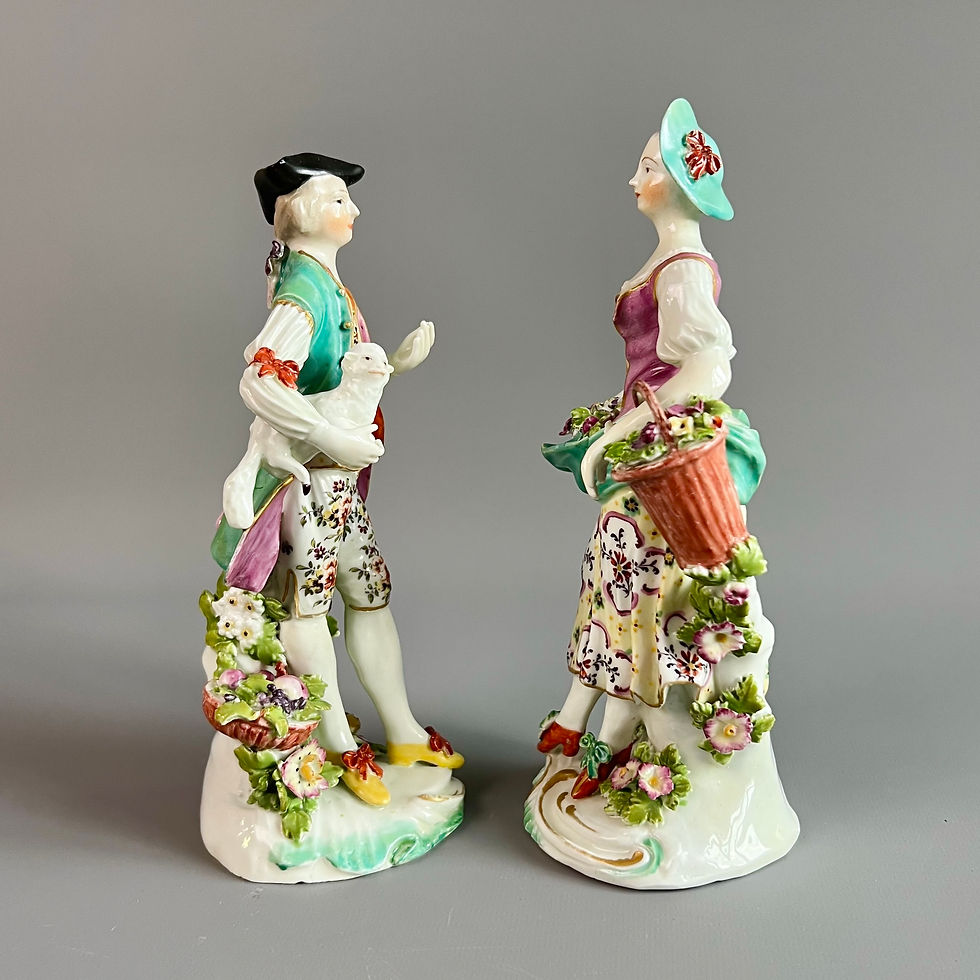
This is a rather rare pair of porcelain figures made by Derby around 1770. The pair was called the "Boy and Girl in Turkish Costumes", numbered 63 in Derby's factory list. They depict two charming toddlers dressed in traditional Turkish garments, with interesting headwear, offering each other flowers.

The Derby Porcelain factory has its roots in the late 1740s, when Andrew Planché, a Walloon Huguenot refugee, started making simple porcelain toys shaped like animals in his back yard. In 1756 Staffordshire enameller William Duysbury and banker John Heath started a new porcelain factory with Planché and this was to grow out to the largest factory of its time, buying up the bankrupted Chelsea and Bow factories, as well as the stock of several other workshops including that of James Giles. The combination of various traditions, porcelain making skills and sophisticated clients enabled Duesbury to create one of the best porcelain factories of the 18th and 19th Centuries, which after many ups and downs is still operative today.

These tiny figures were inspired by Meissen figures, which were first brought out as black-skinned figures in around 1740, modelled by Eberlein. Derby then brought them out the same, and went on to turn them into small white-skinned Turkish children, and Bow made a similar version around the same time. It is thought that the reason they are so tiny (as the originals were larger) is that they were made from secondary moulds - it is also notable that they don't have as great a definition as most other Derby figures.  These "exotic" figures were popular in the 18th Century, when Europeans started to travel (and, sadly, loot!) the world and became curious about other cultures. Today they are an interesting reminder of how these "exotic" cultures seemed so different then, while now, in cities like Derby or London, we all live side by side.

Porcelain figures were used to adorn the dinner table when dessert was served; groups of figures could serve to express something about the host, the guests, or to direct the conversation. Sometimes they were used to show off and challenge everyone's knowledge of the Classics. Originally, figures were made of sugar. But when porcelain became available, it quickly replaced the sugar; a porcelain figure would last forever, while sugar figures would melt down soon after a dinner was finished. There were many series with particular themes, such as pastoral types and animals, musicians, the trades, Greek and Roman mythology and the Elements, Seasons or Virtues.

The figures are unmarked, which is not unusual for this period. They do have the typical patch marks of that period and we know that they are number 63 from the Derby Factory List. You can find them described and pictured in Peter Bradshaw's book on pages 222-223.

CONDITION REPORT: The figures are in good but restored condition; both heads have been knocked off at some point, and have been sympathetically but not entirely invisibly repaired. There are some small typical losses, however both figures still look bright and fresh.
Antique British porcelain is never perfect. Kilns were fired on coal in the 1700s, and this meant that china from that period can have some firing specks from flying particles. British makers were also known for their experimentation, and sometimes this resulted in technically imperfect results. Due to the shrinkage in the kiln, items can have small firing lines or develop crazing over time, which should not be seen as damage but as an imperfection of the maker's recipes, probably unknown at the time of making. Items have often been used for many years and can have normal signs of wear, and gilt can have signs of slight disintegration even if never handled. I will reflect any damage, repairs, obvious stress marks, crazing or heavy wear in the item description but some minor scratches, nicks, stains and gilt disintegration can be normal for vintage items and need to be taken into account.

There is widespread confusion on the internet about the difference between chips and nicks, or hairlines and cracks. I will reflect any damage as truthfully as I can, i.e. a nick is a tiny bit of damage smaller than 1mm and a chip is something you can easily see with the eye; a glazing line is a break in the glazing only; hairline is extremely tight and/or superficial and not picked up by the finger; and a crack is obvious both to the eye and the finger.

DIMENSIONS: Height 11.5cm (4.5") tall, the girl a tiny bit taller than the boy.