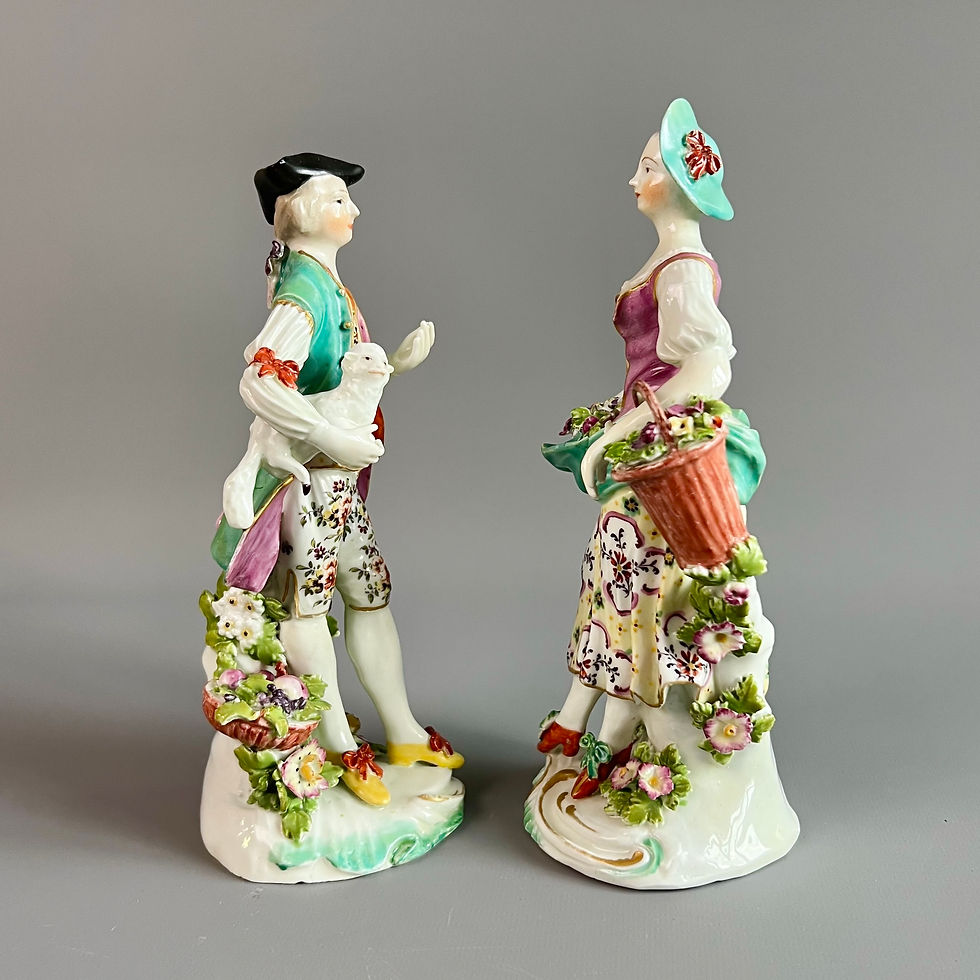
This is a beautiful pair of Derby figures called the "Garland Shepherds", made in about 1765. The pair is one of Derby's most famous figure pairs and it bears the catalogue number E27. This particular pair is very finely made and in excellent condition.
I have had several pairs of these over the years, but this is by far the nicest, not only because of its excellent condition and the light quality of the porcelain, but also because of the tender expression of their faces and the animals; the painter of this pair must have had a particularly good day.
The Derby Porcelain factory has its roots in the late 1740s, when André Planché, a Walloon Huguenot refugee, started making simple porcelain toys shaped like animals. Local entrepeneur William Duysbury took an interest in his skills and worked with him to improve the quality of his wonderfully shaped items. Together they laid the foundations of what would become a very refined tradition of figure making at Derby. In 1769 Duysbury bought up the bankrupted Chelsea factory, incorporating their reputation for high quality figures and tableware; this combination of traditions, porcelain making skills, sophisticated clients and available work people created one of the best porcelain factories of the 18th and 19th Centuries, which after many ups and downs is still operative today.
It is not known what the origin of these figures is, but it is assumed that they might have been modelled after a French engraving after Boucher. The figures have fine clothes painted in fresh colours and are stood on simple base without any scrolling. These figures are clearly inspired by the Romantic movement; if these were true shepherds, imagine them walking over the moors with their silk shoes!
These figures were used to adorn the dinner table when dessert was served; groups of figures served to express something about the host, the guests, or to direct the conversation. One popular topic was an array of romantic rural characters, and this pair is from one such series.
This pair consists of a female shepherdess with a lamb standing up to her, while she places a flower garland around its neck. The male shepherd stands towards her with a letter in his hand; we cannot read exactly what it says but she seems to be carefully listening to his words, her face quietly contemplating the words, with the lamb looking up to her lovingly. The dog is at the male shepherd's feet, looking up as if he wants to be part of the action.
The figures are unmarked but they have three patch marks on the underside, suggesting a date of about 1765.
DOCUMENTATION: The pair is described on page 101 of "Derby Porcelain Figures 1750-1848" by Peter Bradshaw.
CONDITION REPORT: The figures are in unusually good condition without any repairs or damage, other than a few very minor missing petals to the flowers and some tiny nibbles to both hats. The colours are bright and there is no crazing.
Antique British porcelain is never perfect. Kilns were fired on coal in the 1800s, and this meant that china from that period can have some firing specks from flying particles. British makers were also known for their experimentation, and sometimes this resulted in technically imperfect results. Due to the shrinkage in the kiln, items can have small firing lines or develop crazing over time, which should not be seen as damage but as an imperfection of the maker's recipes, probably unknown at the time of making. Items have often been used for many years and can have normal signs of wear, and gilt can have signs of slight disintegration even if never handled. I will reflect any damage, repairs, obvious stress marks, crazing or heavy wear in the item description but some minor scratches, nicks, stains and gilt disintegration can be normal for vintage items and need to be taken into account.
There is widespread confusion on the internet about the difference between chips and nicks, or hairlines and cracks. I will reflect any damage as truthfully as I can, i.e. a nick is a tiny bit of damage smaller than 1mm and a chip is something you can easily see with the eye; a glazing line is a break in the glazing only; hairline is extremely tight and/or superficial and not picked up by the finger; and a crack is obvious both to the eye and the finger.
DIMENSIONS: Height about 19cm (7.5").