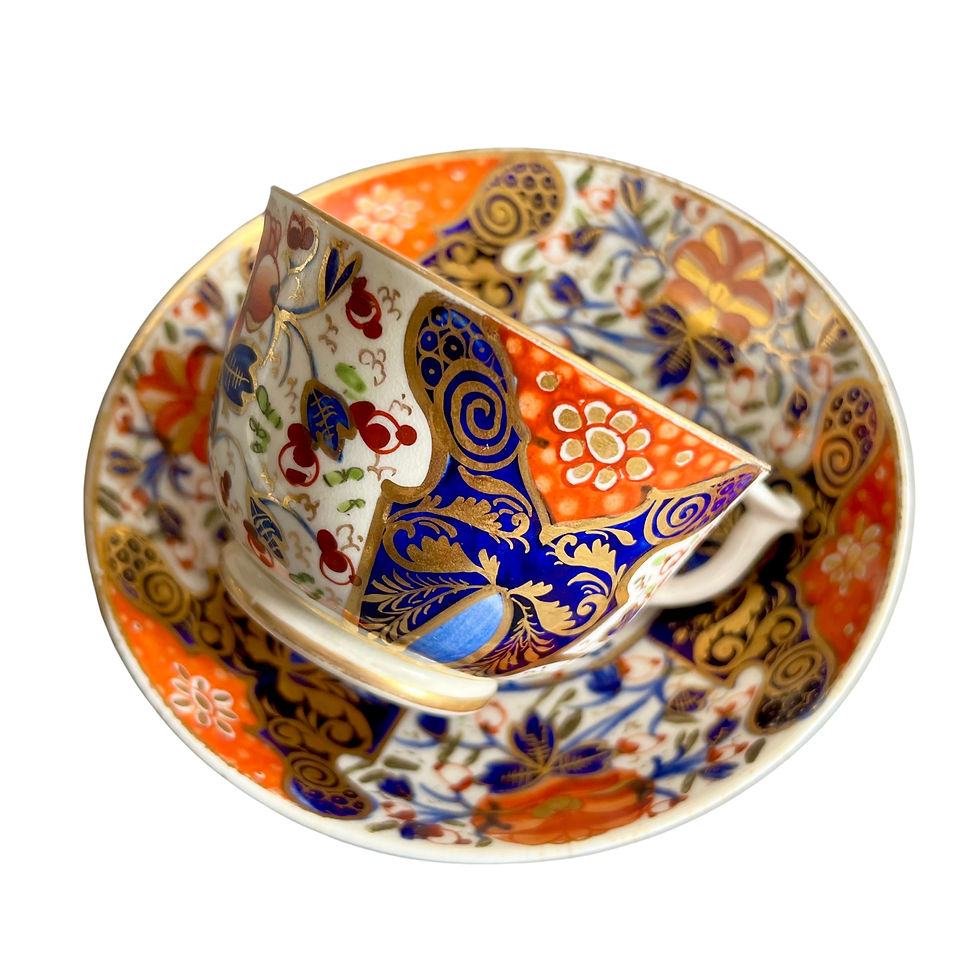
This is a beautiful "true trio" consisting of a teacup, a coffee cup and a saucer, made in around 1840. The set has the "rustic bean" shape with its characteristically elegant bell shape and bean-shaped handles shaped liked twigs, and it is decorated with a bold Imari pattern.
In the late 18th and early 19th Century, cups and saucers were sold in "true trios'; as you would never drink tea and coffee at the same time, the cups would share a saucer.
The Samuel Alcock factory was operative in Staffordshire between 1822 and 1856, after which it was bought by Sir James Duke and Nephews. The factory started as a partnership between the young Samuel Alcock and the older Ralph Stevenson, who provided the factory and capital. Alcock quickly took the factory to great heights, building one of the biggest factories of its time. Alcock jumped on the new Rococo Revival fashion and served a huge new middle class market. The reason we now don't hear much about Samuel Alcock porcelain is that much of it has been mis-identified over the years and attributed to Coalport, Ridgway, Rockingham or others; Alcock did not mark any of his porcelain save a few rare pieces, and the numbering system is difficult to understand. However, the wares are still wide spread and many are of great quality.
The items are unmarked except for the pattern number 6142, as was often the requirement of clients in those days; retailers were worried that people would go to the Potteries directly so therefore kept secret where their items were produced.
CONDITION REPORT The set is in good antique condition except a few minor flaws. There is crazing throughout that has caused various glazing lines on the saucer and the cups, however none of these go into the porcelain so they are of no consequence to the strength of the items. There are two short firing cracks on the rim of the teacup, one of which has been glazed over (see picture), the other has come through the glaze. Neither of these flaws will have bearing on the strength of the cup. There is very little wear.
Antique British porcelain is never perfect. Kilns were fired on coal in the 1800s, and this meant that china from that period can have some firing specks from flying particles. British makers were also known for their experimentation, and sometimes this resulted in technically imperfect results. Due to the shrinkage in the kiln, items can have small firing lines or develop crazing over time, which should not be seen as damage but as an imperfection of the maker's recipes, probably unknown at the time of making. Items have often been used for many years and can have normal signs of wear, and gilt can have signs of slight disintegration even if never handled. I will reflect any damage, repairs, obvious stress marks, crazing or heavy wear in the item description but some minor scratches, nicks, stains and gilt disintegration can be normal for vintage items and need to be taken into account.
There is widespread confusion on the internet about the difference between chips and nicks, or hairlines and cracks. I will reflect any damage as truthfully as I can, i.e. a nick is a tiny bit of damage smaller than 1mm and a chip is something you can easily see with the eye; a glazing line is a break in the glazing only; hairline is extremely tight and/or superficial and not picked up by the finger; and a crack is obvious both to the eye and the finger. Etcetera - I try to be as accurate as I can and please feel free to ask questions or request more detailed pictures!
DIMENSIONS (diameter): teacup 10.8cm (4.25"), coffee cup 9cm (3.5"), saucer 15.2cm (6")