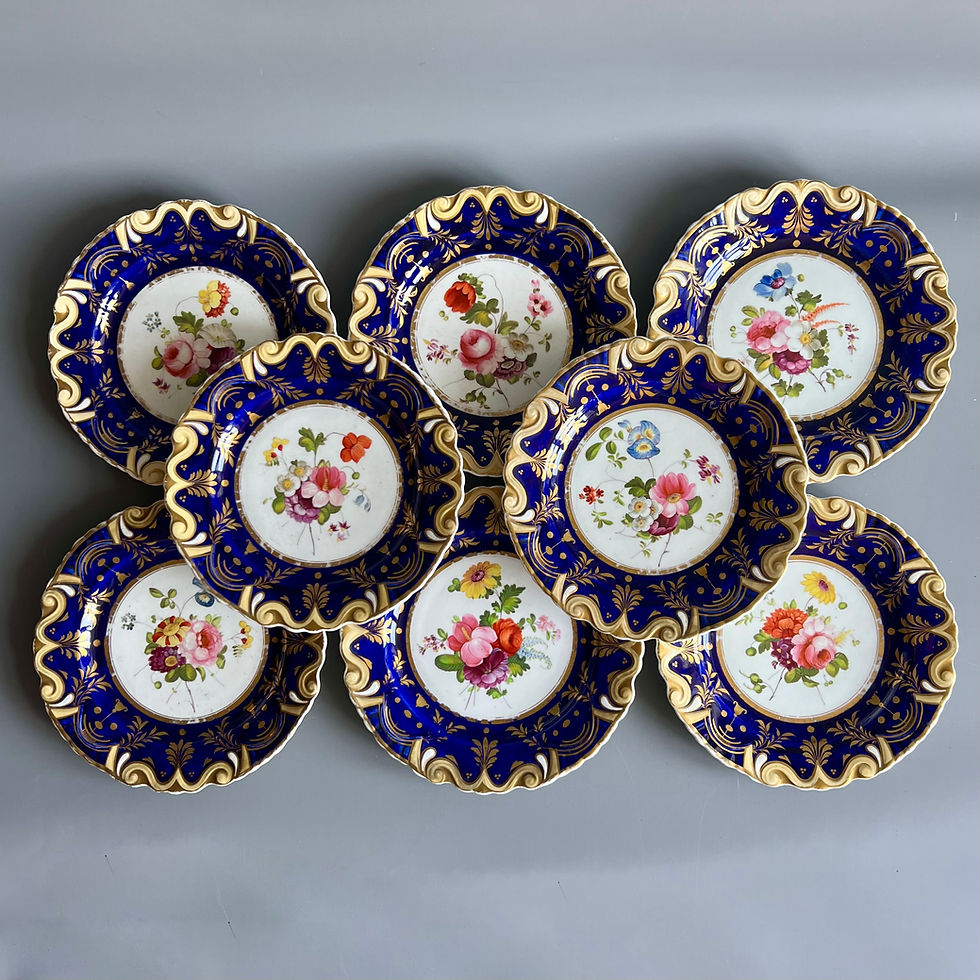
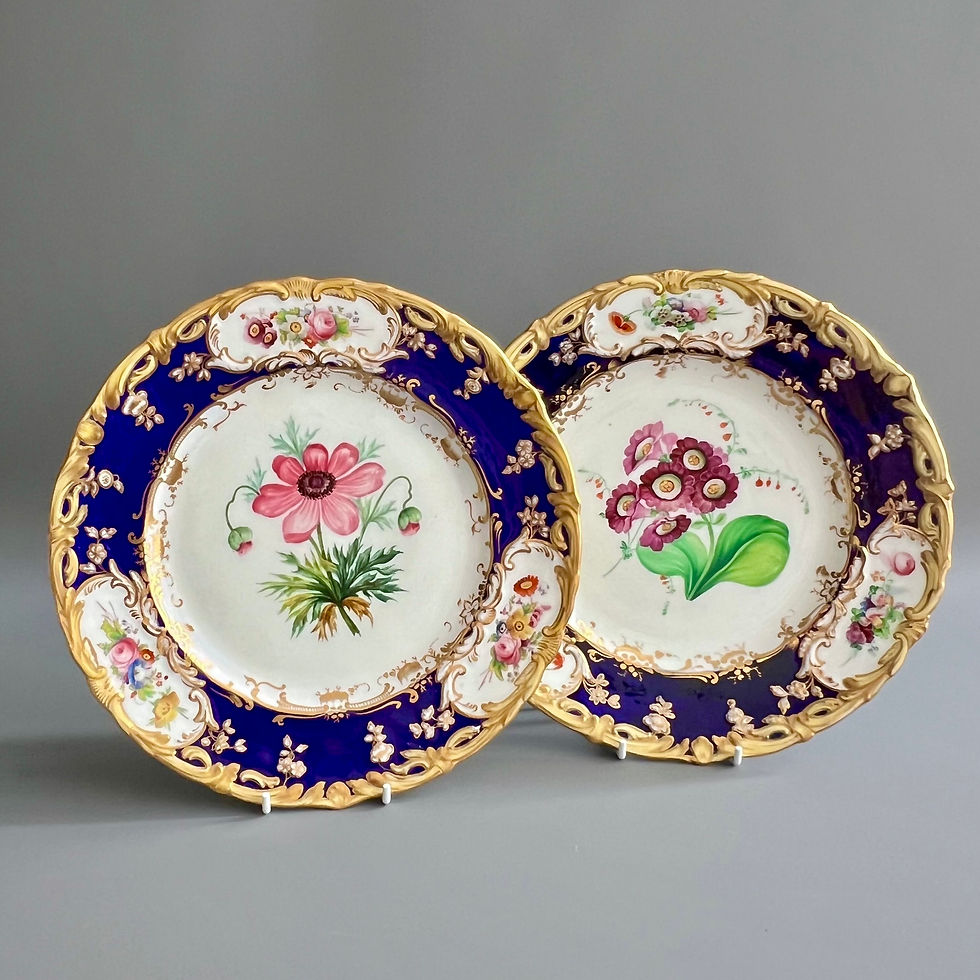
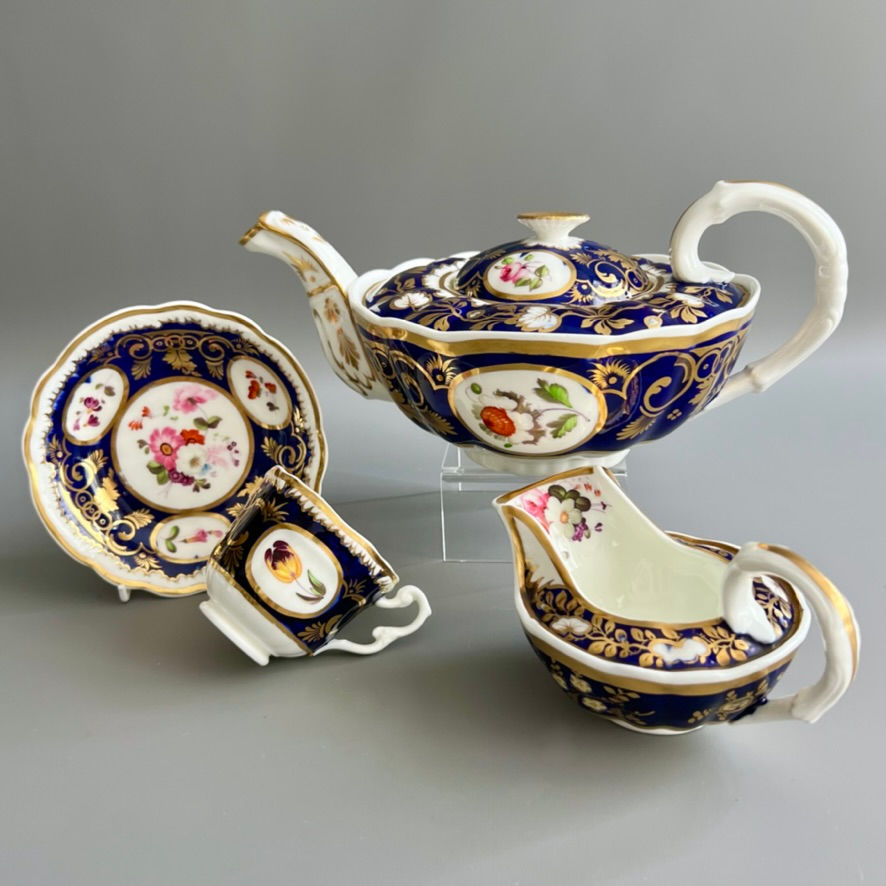
This is a beautiful dessert service made by Machin around 1825, which is known as the Regency period. The service has the famous "moustache" shape, a beautiful cobalt blue ground and hand painted flower reserves. The service consists of two oval dishes, four square shell dishes, and eight plates.
Previously it was thought that these plates were made by Ridgway - a reference by Geoffrey A. Godden, the famous porcelain expert, in his well-known book "Ridgway Porcelains" widely broadcasted this very reasonable assumption. However, recent research has shown that this design was made by Machin, a smaller maker that was equally skilled at producing beautiful porcelain dessert services.
Machin & Co was one of the many potteries in Staffordshire such as Spode, Coalport, H&R Daniel and many others during the 1820s and 1830s. They were in operation between 1812 and 1830 and made very high quality porcelain. As this was not a very long period, their wares are now quite rare and very desired among collectors.
The moustache shape was a popular shape in the 1820s and you can see the moustache shaped moulding on the edges. The plate has a cobalt blue ground with a cream and gilt detail on the moustache shaped rims, and small flower reserves. In the centre of each item is a sublimely painted large flower. Each item is unique; there are no two flowers the same. We know very little about the painters at Machin as they did not document their work, but this service was certainly decorated by a very skilled artist. This pattern has been done in several different versions.
The service is unmarked except the pattern number 690 - this particular pattern was done many times in slightly different variations with different pattern numbers; I have so far sold nearly identical plates with numbers 611, 660, 692, 699, 733 and 848.
CONDITION REPORT The service is in good antique condition without any significant damage, however there are a few minor flaws: one oval dish has some scratches on the flower painting; three shell dishes are crazed with some discolouration; three plates have cracks coming off the rim (not visible from the front) and 3 have crazing and some discolouration. All items have some wear, as visible in the pictures.
Antique British porcelain is never perfect. Kilns were fired on coal in the 1800s, and this meant that china from that period can have some firing specks from flying particles. British makers were also known for their experimentation, and sometimes this resulted in technically imperfect results. Due to the shrinkage in the kiln, items can have small firing lines or develop crazing over time, which should not be seen as damage but as an imperfection of the maker's recipes, probably unknown at the time of making. Items have often been used for many years and can have normal signs of wear, and gilt can have signs of slight disintegration even if never handled. I will reflect any damage, repairs, obvious stress marks, crazing or heavy wear in the item description but some minor scratches, nicks, stains and gilt disintegration can be normal for vintage items and need to be taken into account.
There is widespread confusion on the internet about the difference between chips and nicks, or hairlines and cracks. I will reflect any damage as truthfully as I can, i.e. a nick is a tiny bit of damage smaller than 1mm and a chip is something you can easily see with the eye; a glazing line is a break in the glazing only; hairline is extremely tight and/or superficial and not picked up by the finger; and a crack is obvious both to the eye and the finger. Etcetera - I try to be as accurate as I can and please feel free to ask questions or request more detailed pictures!
DIMENSIONS (diameters): oval dishes 28cm X 22cm (11" X 8.75"); shell dishes 23cm X 21.5cm (9" X 8.5");plates 21.5cm (8.5") diameter.