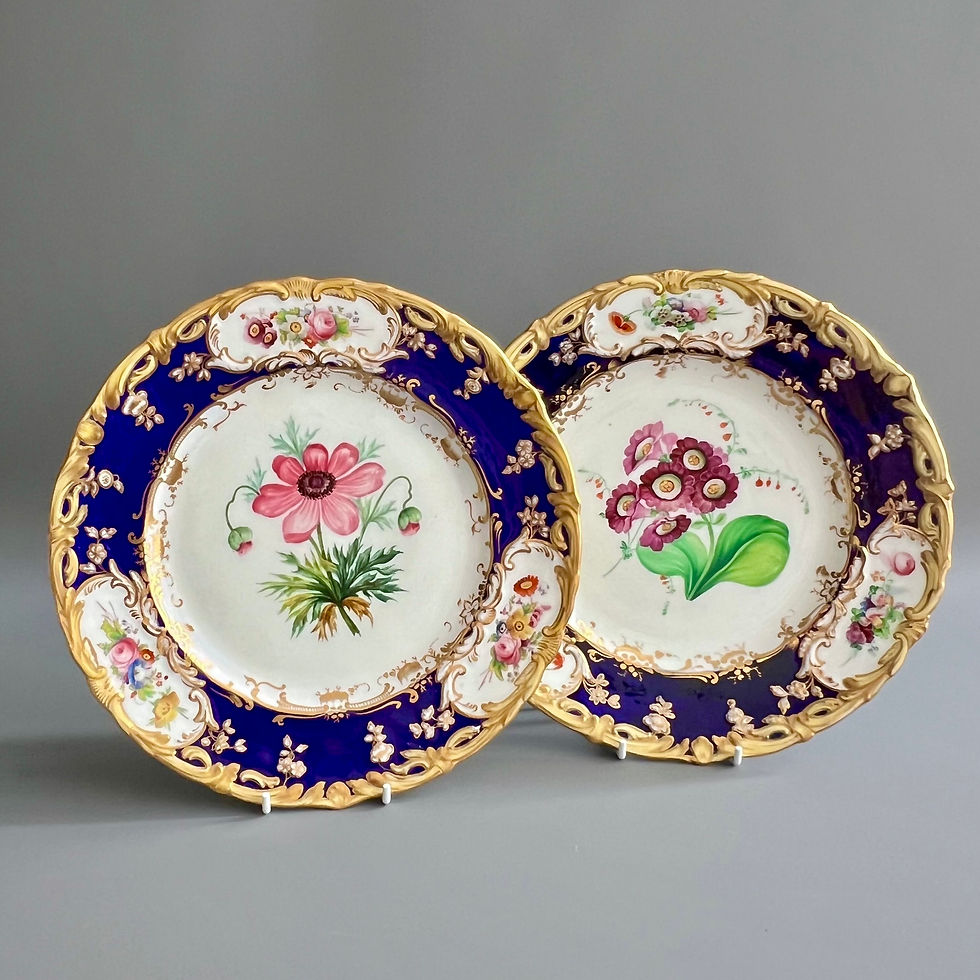
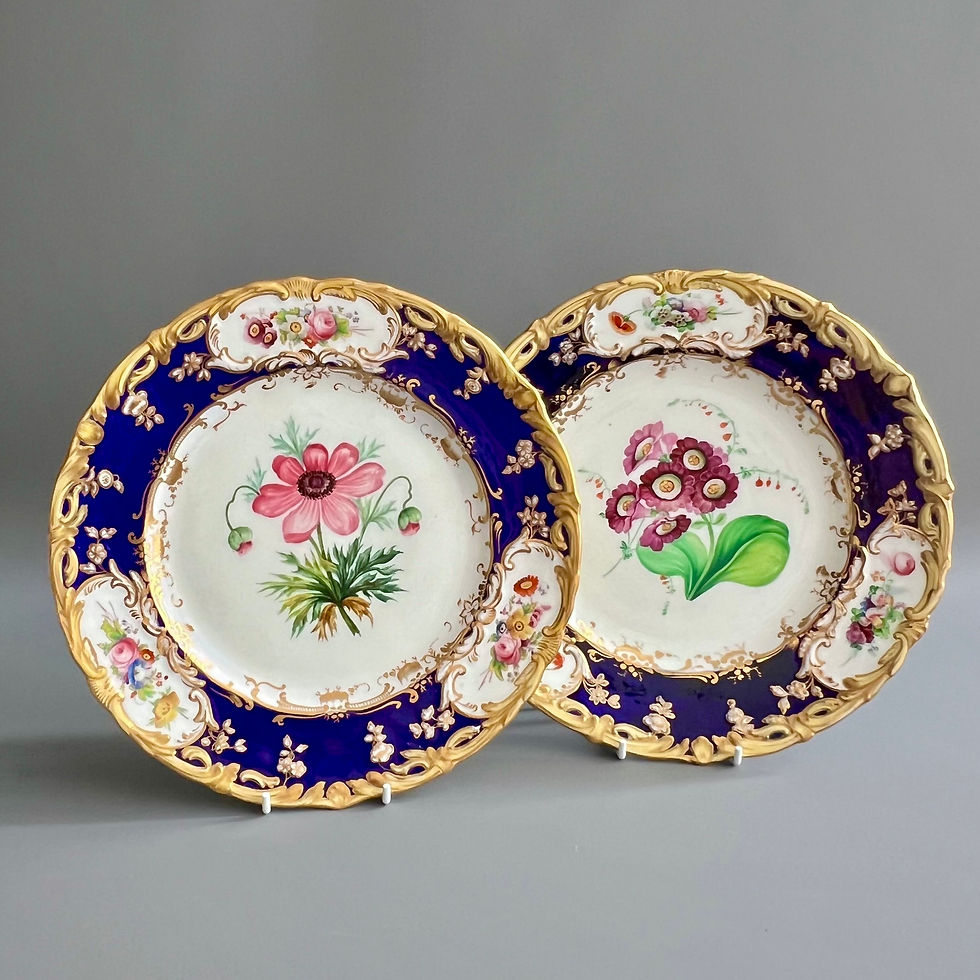
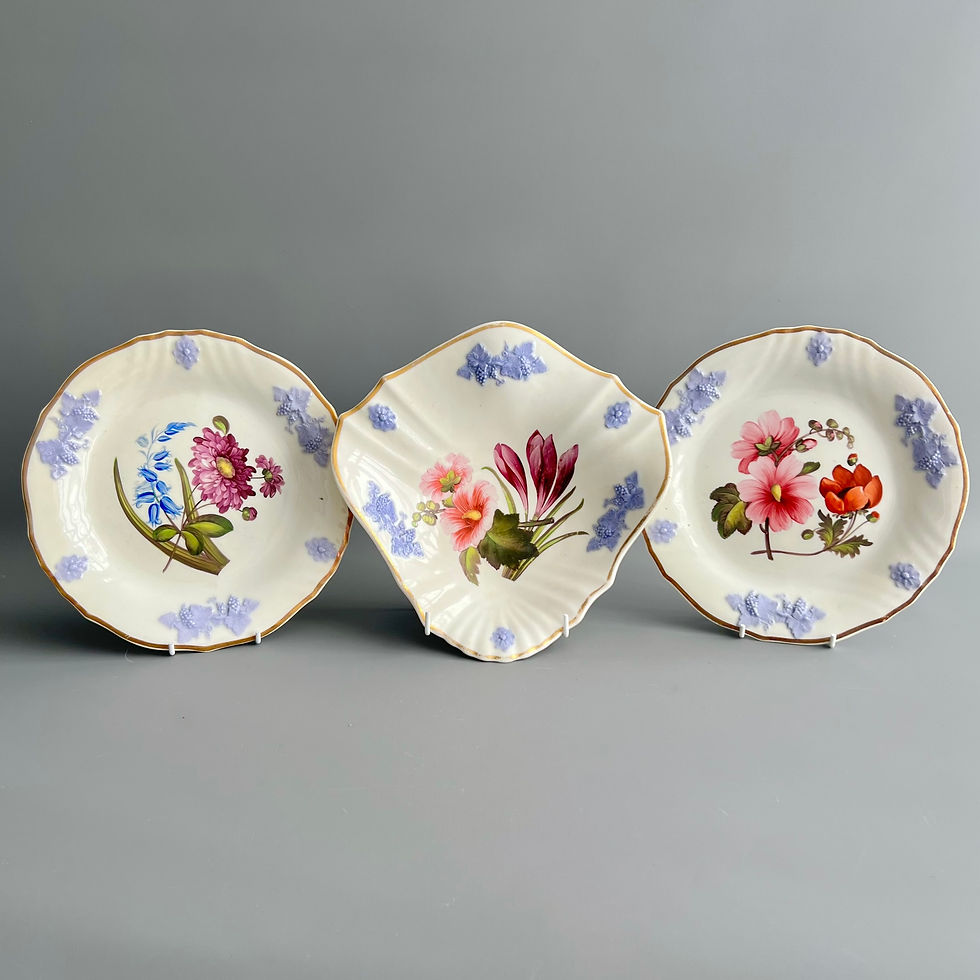
This is a beautiful plate made by John Rose at Coalport in about 1805. The plate was most probably decorated in the London studio of the famous porcelain artist Thomas Baxter with a beautifully painted landscape of a ruined abbey by a river, set in a border of pink and elaborate gilt patterns. Coalport had many of their best items decorated in London in this period.
Coalport was one of the leading potters in 19th and 20th Century Staffordshire. They worked alongside other great potters such as Spode, Davenport and Minton, and came out with many innovative designs. When we say "Coalport" we usually think of the one Coalport factory that became famous, but in its beginning years there were two factories, one run by John Rose and the other by his brother Thomas Rose. Thomas Rose went into partnership with Robert Anstice and Robert Horton and they were located directly opposite John Rose, across the canal. The brothers' factories had much in common with each other and they shared many different shapes and patterns. Ultimately, the John Rose factory proved more profitable and John Rose bought Thomas' factory in 1814, making it the one Coalport factory that became so famous. Many of the Coalport items, of either factory, are now collectors' items.
This plate was in all likelihood painted in the studio of the famous porcelain painter Thomas Baxter (1782-1821). Although this painting is not from Baxter's hand, it was painted in his style, probably under his direct guidance. Baxter was the son of a porcelain painting family and learned the basics from his father, who ran a studio in London. He later ran his own studio and art school, becoming a well-known teacher of porcelain painting, and he was employed at various times by the Worcester and Swansea potteries, where he painted many top pieces. He also became very well-known for a beautiful dinner service he painted for Lord Nelson, who became his patron and commissioned many pieces from him. Unfortunately Baxter died young in 1821 at the age of 39, but he left behind an impressive output of wonderful pieces, as well as many pieces painted by others under his guidance.
This plate would have been part of a large dessert service. It was potted in early bone china - not as smooth as it was to become only a few years later when recipes improved, and with many little blemishes. The plate has a beautiful landscape in the centre of a ruined abbey by a river; the colours are exquisite. You can see the variety of trees and shrubs, and how the light comes through; one of the trees has a beautiful blueish hue. Around the centre is a band of soft pink with little purple details, and a stunning border of gilt floral festoons, a hallmark of the Neoclassical style that was popular at the time.
The plate is unmarked, as was usual in those days; there is the number 33 painted in yellow, which is probably the gilder's or painter's number.
CONDITION REPORT The plate is in very good antique condition without any damage, crazing or repairs. The porcelain is imperfect as it is early British porcelain; there is some wear throughout as visible in the pictures.
Antique British porcelain is never perfect. Kilns were fired on coal in the 1800s, and this meant that china from that period can have some firing specks from flying particles. British makers were also known for their experimentation, and sometimes this resulted in technically imperfect results. Due to the shrinkage in the kiln, items can have small firing lines or develop crazing over time, which should not be seen as damage but as an imperfection of the maker's recipes, probably unknown at the time of making. Items have often been used for many years and can have normal signs of wear, and gilt can have signs of slight disintegration even if never handled. I will reflect any damage, repairs, obvious stress marks, crazing or heavy wear in the item description but some minor scratches, nicks, stains and gilt disintegration can be normal for vintage items and need to be taken into account.
There is widespread confusion on the internet about the difference between chips and nicks, or hairlines and cracks. I will reflect any damage as truthfully as I can, i.e. a nick is a tiny bit of damage smaller than 1mm and a chip is something you can easily see with the eye; a glazing line is a break in the glazing only; hairline is extremely tight and/or superficial and not picked up by the finger; and a crack is obvious both to the eye and the finger. Etcetera - I try to be as accurate as I can and please feel free to ask questions or request more detailed pictures!
DIMENSIONS 21cm (8.25") diameter