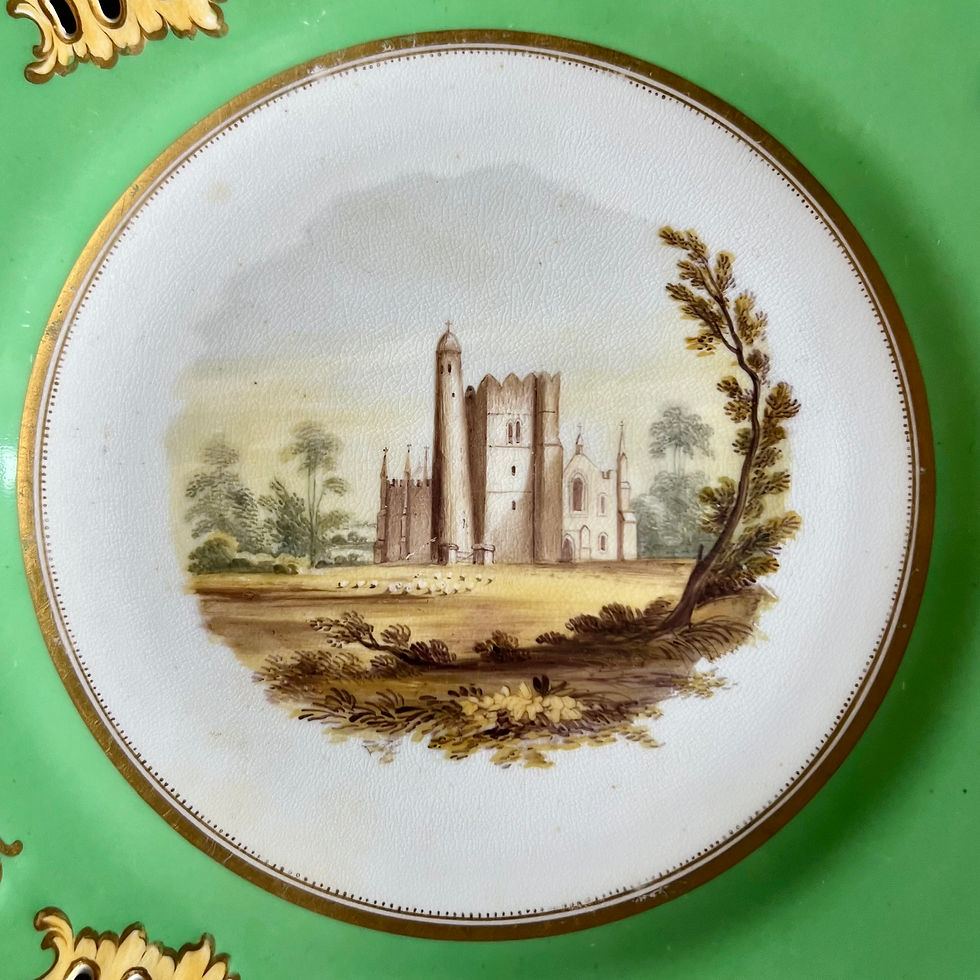
This is an very rare and beautiful teacup and saucer made by H&R Daniel some time around 1830. The set is potted in the plain variation on the "second gadroon" shape and is decorated with an emerald green band with gilt floral sprigs and beautiful wildflowers painted in the centre of each item.
The H & R Daniel porcelain factory was founded by Henry Daniel, son of a family of master colour makers. He headed up the decoration department in the famous Spode factory where he oversaw all the beautiful early Spode decorations. In 1822 he opened his own factory with his son Richard, creating a truly iconic body of work with the most subtle colours and beautifully painted flowers and landscapes.
The Daniel factory was the last true cottage industry among the English porcelain factories, resisting the increase of industrialisation and mass production. This resulted in extraordinary and unrivalled quality, but it probably also led to the factory having to close its doors in 1846 because it could no longer compete with others who did modernise. Daniel porcelain can be hard to identify as the factory was only around for about two decades, but this short duration and the low output also means that Daniel items have become true collectors' items.
The set is unmarked, as is quite normal for items of that period; there is no pattern number and the pattern number is unknown. It was given the number D067 and is shown on page 78 in Susan & Gordon Pickett's "Daniel Patterns on Porcelain Tablewares".
CONDITION REPORT The set is in good antique antique condition without damage or repairs, and only some minimal wear. Like many H&R Daniel items of this era, both cup and saucer are crazed. There is a small production fault on the rim of the saucer, which has been painted over during production; a sign that this set was made in a hurry, perhaps a special commission.
Antique British porcelain is never perfect. Kilns were fired on coal in the 1800s, and this meant that china from that period can have some firing specks from flying particles. British makers were also known for their experimentation, and sometimes this resulted in technically imperfect results. Due to the shrinkage in the kiln, items can have small firing lines or develop crazing over time, which should not be seen as damage but as an imperfection of the maker's recipes, probably unknown at the time of making. Items have often been used for many years and can have normal signs of wear, and gilt can have signs of slight disintegration even if never handled. I will reflect any damage, repairs, obvious stress marks, crazing or heavy wear in the item description but some minor scratches, nicks, stains and gilt disintegration can be normal for vintage items and need to be taken into account.
There is widespread confusion on the internet about the difference between chips and nicks, or hairlines and cracks. I will reflect any damage as truthfully as I can, i.e. a nick is a tiny bit of damage smaller than 1mm and a chip is something you can easily see with the eye; a glazing line is a break in the glazing only; hairline is extremely tight and/or superficial and not picked up by the finger; and a crack is obvious both to the eye and the finger. Etcetera - I try to be as accurate as I can and please feel free to ask questions or request more detailed pictures!
DIMENSIONS (diameters) cup 10cm (4"); saucer 14.5cm (5.75").