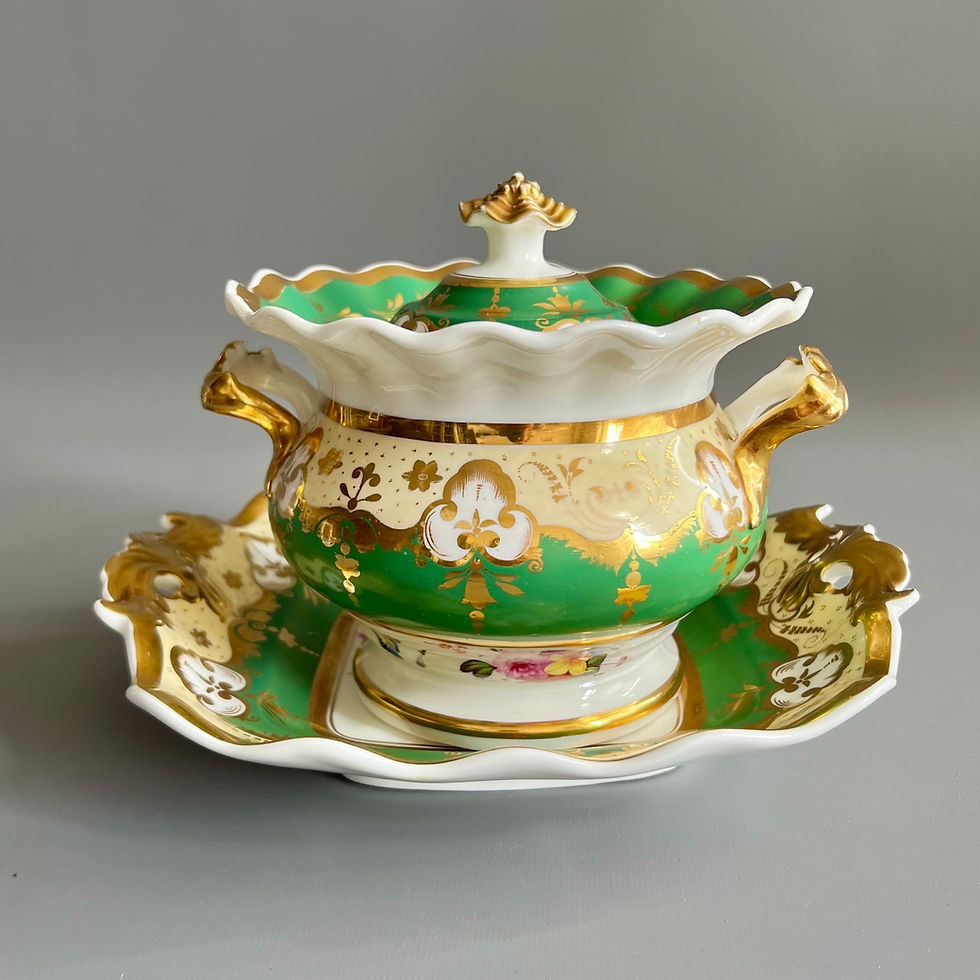
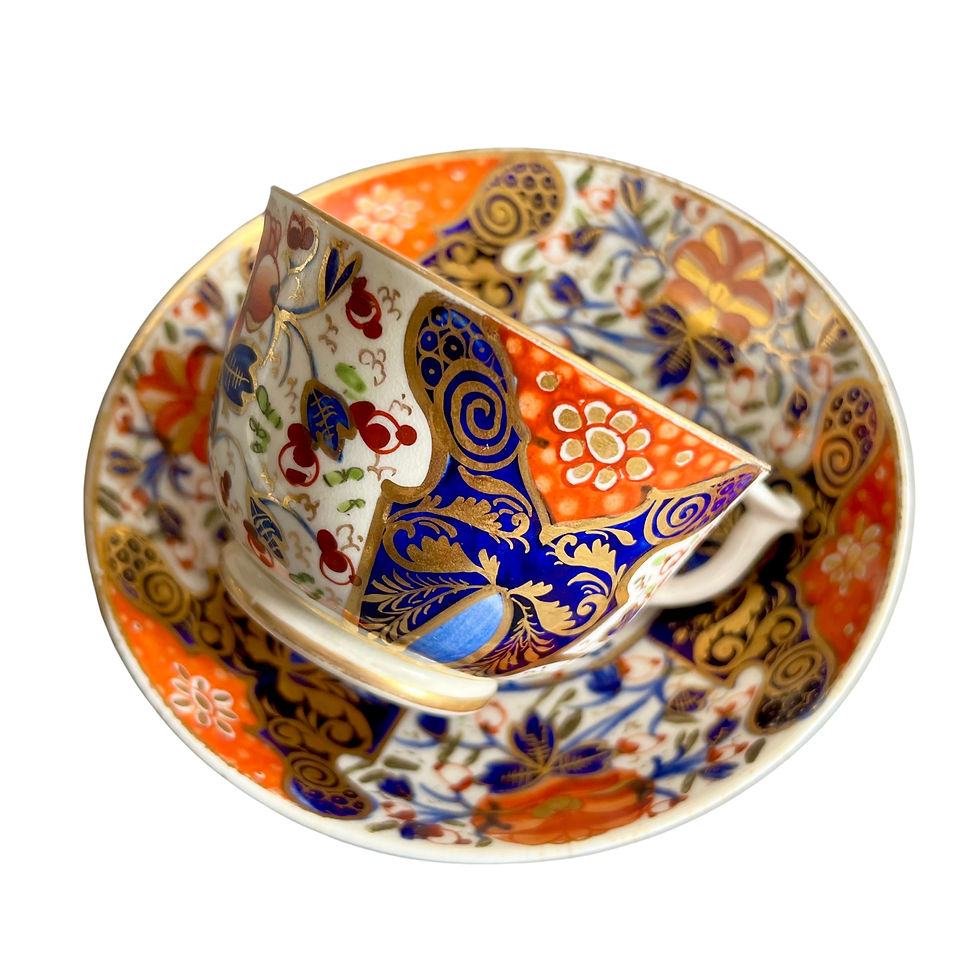
This is a beautiful one-handled dessert serving dish or "shell" dish made by Bloor Derby in about 1825 in the Regency era, and painted with floral sprigs by Moses Webster. These dishes were to serve dessert, and the handle makes it convenient to pass around the table.
The Derby factory, later reshaped into Royal Crown Derby, is currently the oldest British porcelain factory still in production. Derby was one of the most prominent potteries right from the start of English porcelain production in the mid 1700s to today. Their items are of exceptionally high quality and many of the designs have become iconic, particularly the Imari designs; many of these are still being made today. Derby made many exciting designs in the Regency era, and when Robert Bloor bought the factory he initiated many elaborate designs. This dish was painted in abotu 1825, when the company was called "Bloor Derby".
Derby became famous for very fine flower paintings, and the decoration of very finely painted flower garlands and beautiful bouquet in the centre of the plate is a testament to that. The flowers were painted by Moses Webster, who spent most of his life working for Derby (from about 1825 to his death in 1870).
Webster worked at Worcester for a short period between 1821 and 1825, however he didn't like it there as he was not allowed to paint roses, which were his favourite flower and which he had learned to paint from the famous William Billingsley. He kept smuggling in roses, and one day one of his fellow young painters put this impromptu on his work bench:
“If Moses composes
His posies of roses
Of sweeter he can’t them compose;
No flower else that grows
Can compare with the rose,
If you doubt it consult your own nose.”
(Flight and Barr Worcester Porcelain by Henry Sandon, page 209)
This dish is marked with the red Derby mark that was used between 1806 and 1825.
CONDITION REPORT The dish is in very good condition without any damage or repairs, however it is crazed throughout, as visible in the pictures. There are two tiny and insignificant firing cracks in the rim, one of which is shown in the last picture. These do not stand out at all and were caused during production.
Antique British porcelain is never perfect. Kilns were fired on coal in the 1800s, and this meant that china from that period can have some firing specks from flying particles. British makers were also known for their experimentation, and sometimes this resulted in technically imperfect results. Due to the shrinkage in the kiln, items can have small firing lines or develop crazing over time, which should not be seen as damage but as an imperfection of the maker's recipes, probably unknown at the time of making. Items have often been used for many years and can have normal signs of wear, and gilt can have signs of slight disintegration even if never handled. I will reflect any damage, repairs, obvious stress marks, crazing or heavy wear in the item description but some minor scratches, nicks, stains and gilt disintegration can be normal for vintage items and need to be taken into account.
There is widespread confusion on the internet about the difference between chips and nicks, or hairlines and cracks. I will reflect any damage as truthfully as I can, i.e. a nick is a tiny bit of damage smaller than 1mm and a chip is something you can easily see with the eye; a glazing line is a break in the glazing only; hairline is extremely tight and/or superficial and not picked up by the finger; and a crack is obvious both to the eye and the finger. Etcetera - I try to be as accurate as I can and please feel free to ask questions or request more detailed pictures!
DIMENSIONS 21cm (8.25") X 23.5cm (9.25")