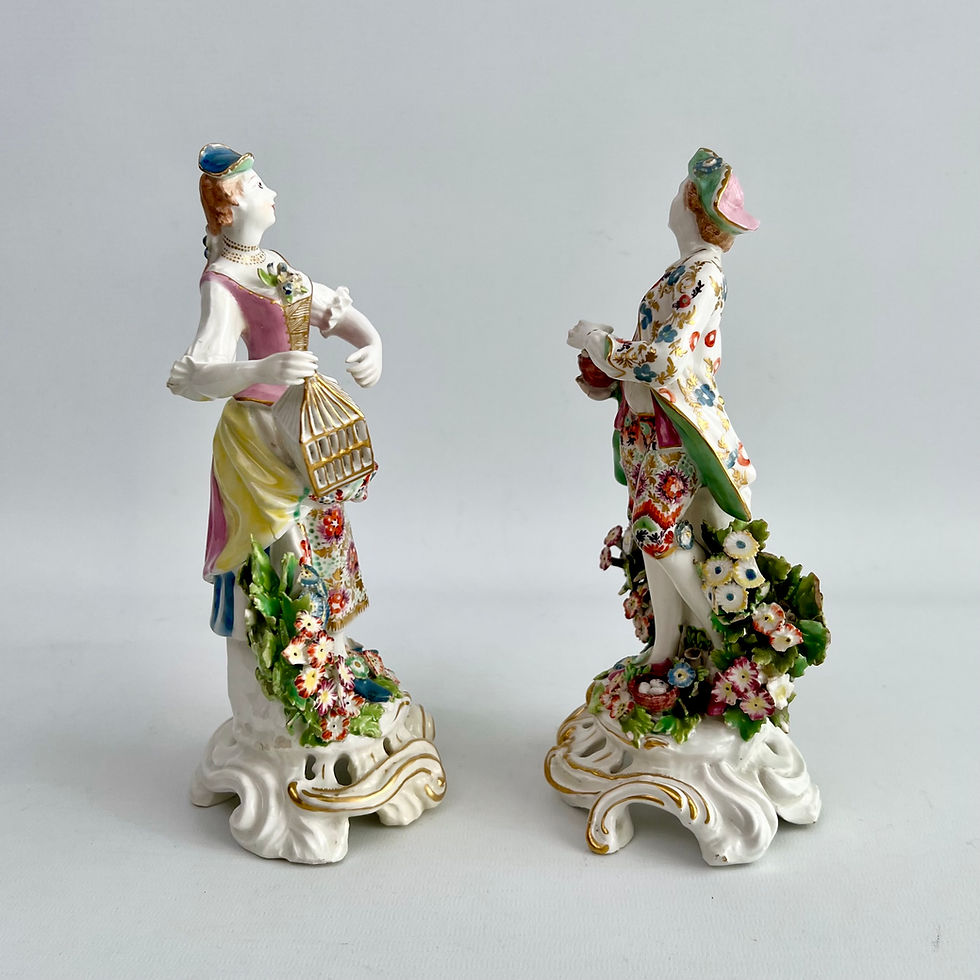
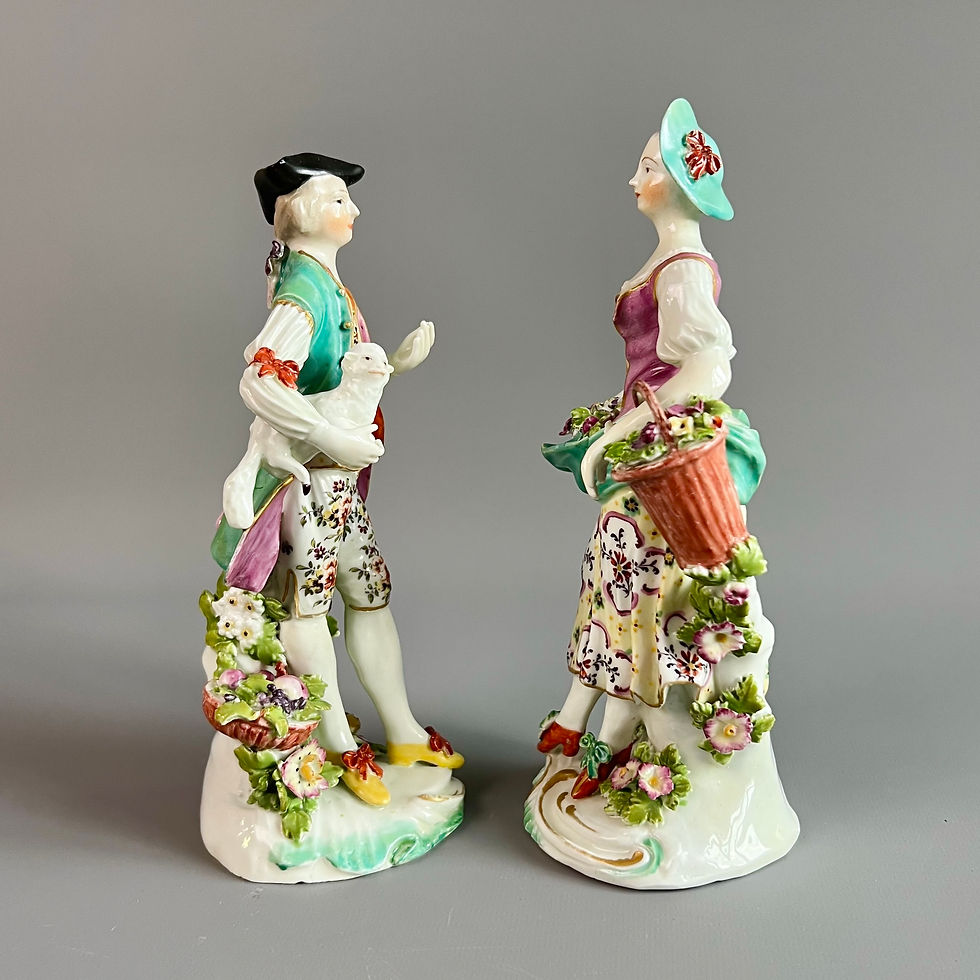
This is a very rare and impressive complete set of large figures called The Four Elements, made by the Bow Porcelain factory in about 1765. It consists of Ceres representing Earth, Vulcan representing Fire, Neptune representing Water andJuno representing Air.
The Bow Porcelain Factory was one of the first potteries in Britain to make soft paste porcelain, and most probably the very first to use bone ash, which later got perfected by Josiah Spode to what is now the universally used "bone china". Bow was the main competitor of the Chelsea Porcelain Factory, but where Chelsea made very fine slipcast porcelain, Bow made a different soft paste porcelain that tended to be softer and could be pressed into moulds. Bow served a larger public generally at lower prices. The factory was only in operation between 1743 and 1774, after which the tradition got incorporated into some of the later famous potteries such as Worcester and Derby.
These figures were used to adorn the dinner table when dessert was served; groups of figures served to express something about the host, the guests, or to direct the conversation. A favourite pastime of the period was to guess the nature of Classical gods and goddesses, and thus show off one's erudition.
These figures date from about 1765, which was at the height of Bow's ability to make beautiful figures often copied from Chelsea or Meissen. The porcelain is translucent with a beautiful milky glaze.
These figures are based on sculptures that can be found in the gardens of Versailles.
Ceres is based on "La Terre" by Benoit Massou, which stands at the Parterre du Nord. She holds a cornucopia filled to the brim with fruits and flowers, signifying the Fruits of the Earth; beside her is a large recumbent lion, signifying the Kingdom of Animals.
Vulcan is based on a sculpture called "Le Feu" by Nicolas Dossier, which stands at the Parterre de Latone. Again the female original has been adapted to a male, this time an effeminate youth. We see Vulcan standing by a flaming brazier, warming his hands; at his feet is a phoenix issuing from flames.
Neptune is based on a marble called "L'Eau" by Pierre Legros, which stands at the Fontaine du Point du Jour. But while Legros' sculpture depicts a female, Bow has turned this into the mature, bearded male Neptune, pouring water from an urn. Beside him is a large dolphin in bright colours.
Juno is based on a sculpture called "L'Air" by Étienne le Hongre, which stands at the Parterre d'Eau. We see her waving her garment, signifying air, and at her feet is Jupiter, appropriately in his favourite guise of an eagle. Jupiter is both Juno's husband and twin brother (that's a rather complicated story!) and often appears in disguise.
The figures are not marked, which is quite common for Bow figures. Images of these figures can be found in Peter Bradshaw's book on Bow Porcelain Figures, page 193, plates 203 and 204, with the description on pages 100-101.
All figures are stood on beautiful high Rococo scrolls; three of them are identically coloured in puce and gilt, but Neptune has more blue, suggesting that this set was matched at some point.
Provenance: The John Buckingham Collection.
CONDITION REPORT Some of the figures have some restoration but they overall look stunning. Ceres (Earth) has one restored foot on the base, restoration to the cornucopia, right arm, cape and neck, and some typical small losses to the encrusted flowers. Vulcan (Fire) has some losses to the flames of the phoenix and a few fingers of the left hand missing. Neptune (Water) has no damage other than some tiny losses to his crown of weeds. Juno (Air) is in perfect condition.
The restorations are dated and some of the missing elements such as fingers and flames could be easily added; if desired we can arrange for the restorations to be redone by modern standards, which would make them entirely invisible and we would charge at cost price. Please note that it might take some time to book a slot with one of our approved restorers.
Antique British porcelain is never perfect. Kilns were fired on coal in the 1700s, and this meant that china from that period can have some firing specks from flying particles. British makers were also known for their experimentation, and sometimes this resulted in technically imperfect results. Due to the shrinkage in the kiln, items can have small firing lines or develop crazing over time, which should not be seen as damage but as an imperfection of the maker's recipes, probably unknown at the time of making. Items have often been used for many years and can have normal signs of wear, and gilt can have signs of slight disintegration even if never handled. I will reflect any damage, repairs, obvious stress marks, crazing or heavy wear in the item description but some minor scratches, nicks, stains and gilt disintegration can be normal for vintage items and need to be taken into account.
There is widespread confusion on the internet about the difference between chips and nicks, or hairlines and cracks. I will reflect any damage as truthfully as I can, i.e. a nick is a tiny bit of damage smaller than 1mm and a chip is something you can easily see with the eye; a glazing line is a break in the glazing only; hairline is extremely tight and/or superficial and not picked up by the finger; and a crack is obvious both to the eye and the finger. Etcetera - I try to be as accurate as I can and please feel free to ask questions or request more detailed pictures!
DIMENSIONS 29cm high (11.5").